Welcome to Your Rejuvenation Journey
Understanding facial aging: As we age, collagen, elastin, and hyaluronic acid diminish, leading to skin laxity, fine lines, volume loss, and sagging. Both surgical and non‑surgical options address these changes. Overview of treatment options: Surgical facelifts, brow lifts, blepharoplasty, and neck lifts provide lasting structural correction for significant laxity. Non‑surgical modalities such as neurotoxins (Botox, Xeomin), hyaluronic‑acid fillers, laser resurfacing, microneedling, and ultrasound‑based tightening offer modest, temporary improvements with minimal downtime. What to expect during your first visit: A board‑certified surgeon or dermatologist will review your medical history, assess skin quality, discuss realistic goals, and outline a personalized plan that may combine procedures to achieve natural, long‑lasting results. Consultation includes discussion of contraindications such as smoking or medical conditions care.
Understanding Patient Preferences and Decision‑Making
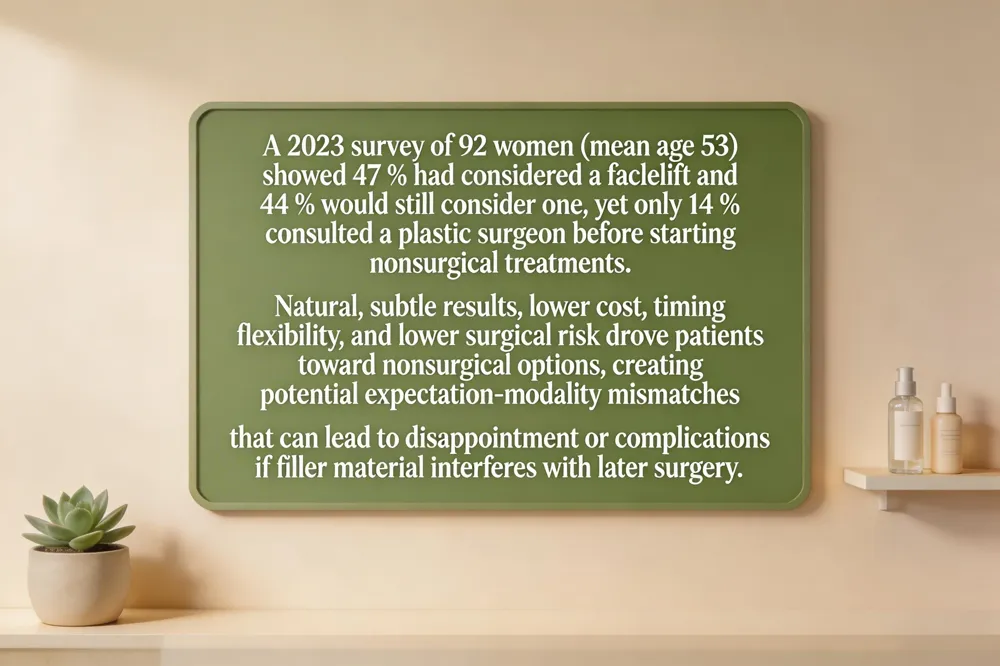 A 2023 survey of 92 women (mean age 53) seeking total‑face nonsurgical rejuvenation revealed that 47 % had contemplated a facelift and 44 % would still consider one later, yet only 14 % had actually consulted a plastic surgeon before starting nonsurgical treatments. The most common motivations for choosing nonsurgical options were the desire for natural, subtle results; lower cost; flexibility in timing; concerns about surgical/anesthetic risks, downtime, scarring, and the ability to spread treatments over time. Because many patients decide on surgical versus nonsurgical pathways before professional advice, mismatches can arise between their expectations and the modality’s capabilities, potentially leading to disappointment or complications if residual filler material interferes with future surgery.
Facial rejuvenation cost – In the U.S., a typical facelift averages $9,600, while brow lifts and blepharoplasty range $3,400–$3,500. Non‑surgical procedures such as laser resurfacing, chemical peels, or injectables cost $150–$3,000 per session. These elective services are usually not covered by insurance, though many practices, including Dermatology Associates, PC, offer financing and bundled discounts.
Skin rejuvenation treatment at home – FDA‑cleared at‑home fractional lasers, LED red‑light masks, and micro‑current tools can safely improve texture, elasticity, and fine lines when used per manufacturer guidelines. Pairing devices with antioxidant serums enhances results, but patients should consult a dermatologist to ensure suitability.
Facial rejuvenation Indiana reviews – Patients consistently praise Dermatology Associates, PC for personalized care, natural‑looking outcomes, and a compassionate, no‑pressure environment. Positive feedback highlights effective microneedling, laser resurfacing, and injectable therapies, reinforcing the practice’s reputation for trustworthy facial rejuvenation in Indiana.
Surgical Options: What They Offer and Who They Suit
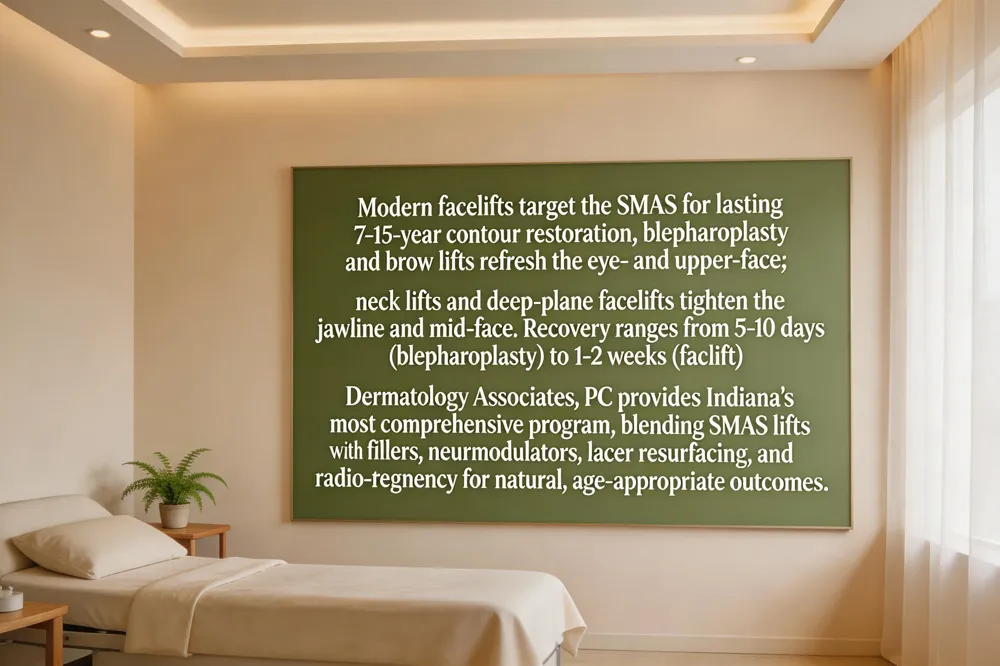 Facelift anatomy and SMAS technique – Modern facelifts address sagging skin by repositioning the deeper Superficial Musculoaponeurotic System (SMAS) rather than merely tightening skin. The SMAS lift restores facial contours, reduces jowls, and provides results that can last 7‑15 years.
Blepharoplasty and brow lift benefits – Eyelid surgery removes excess skin and fat, improving vision and eliminating under‑eye bags, while brow lifts elevate the eyebrows and smooth forehead creases. Together they create a refreshed eye area and a more youthful upper face.
Neck lift and deep plane considerations – Neck lifts (platysmaplasty) tighten platysma bands and trim excess skin, restoring jawline definition. Deep‑plane facelifts combine SMAS and deep tissue repositioning for comprehensive rejuvenation of the mid‑face, lower face, and neck.
Recovery timelines and downtime – Surgical facelifts typically require 1‑2 weeks of visible swelling and bruising, with full aesthetic results emerging by 4‑6 weeks. Blepharoplasty and brow lifts have shorter recoveries (5‑10 days), while neck lifts may need 10‑14 days before returning to normal activities.
Best facial rejuvenation Indiana – Dermatology Associates, PC offers Indiana’s most comprehensive program, blending FDA‑approved Botox, Xeomin, Juvéderm, RHA, and Radiesse with laser resurfacing, radio‑frequency tightening, and SMAS facelifts for natural, age‑appropriate outcomes.
Full face facial rejuvenation Indiana – A personalized blend of SMAS facelifts, fat grafting, brow lifts, and liquid facelift protocols (injectable neuromodulators and fillers) delivers lasting volume restoration and skin texture improvement, complemented by laser and PRP therapies.
What is the new undetectable facelift? – It is a “natural” facelift that focuses on restoring facial anatomy—targeting deeper tissues, preserving volume, and achieving subtle, harmonious results without obvious surgical signs.
Non‑Surgical Modalities: Tools and Results
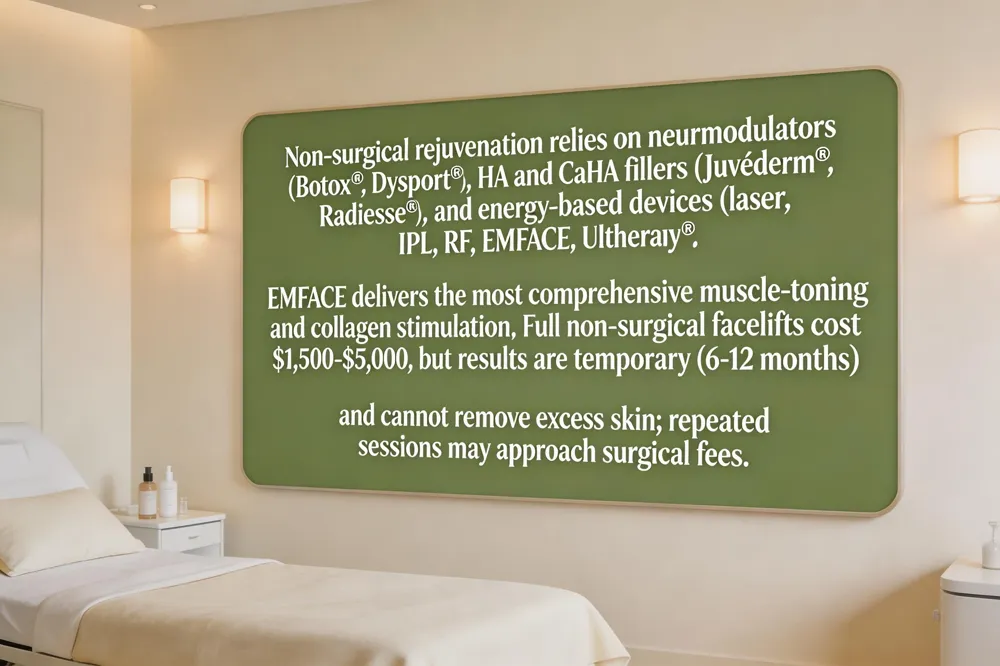 Non‑surgical facial rejuvenation relies on three pillars—muscle toning, volume restoration, and collagen stimulation. Neuromodulators such as Botox® or Dysport® temporarily relax dynamic wrinkles, while hyaluronic‑acid and calcium‑hydroxylapatite fillers (e.g., Juvéderm®, Radiesse®) restore lost cheek, lip, and nasolabial‑fold volume. Laser, IPL, and radio‑frequency (RF) technologies (e.g., Halo® hybrid laser, BBL® IPL, Morpheus8 RF‑microneedling) improve texture, pigmentation, and skin tightness by inducing neocollagenesis with minimal downtime. EMFACE, a hybrid of high‑intensity focused electromagnetic (HIFEM) and synchronized RF, produces supramaximal facial‑muscle contractions and deep dermal heating, delivering a whole‑face lift that tightens and smooths skin for up to a year. Ultrasound‑guided lifts (Ultherapy®) and focused‑ultrasound (HIFU) target the SMAS and deep fascia to lift jowls and jawline without incisions. Energy‑based options such as Morpheus8 and PDO thread lifts combine mechanical lift with collagen remodeling, making them ideal for moderate skin laxity and texture refinement.
Best non‑surgical rejuvenation: EMFACE offers the most comprehensive muscle‑toning and collagen‑stimulating effect, surpassing traditional injectables.
Cost: A full non‑surgical facelift typically ranges $1,500–$5,000, often $2,500–$4,000 for combined ultrasound, fillers, and RF.
Disadvantages: Results are temporary (6–12 months), may require repeated sessions, cannot remove excess skin, and cumulative costs can approach surgical fees.
Jowl treatment: HIFU/Ultherapy and Morpheus8 are top choices, with PDO threads or strategic filler placement as adjuncts.
Combining Surgical and Non‑Surgical Approaches for Longevity
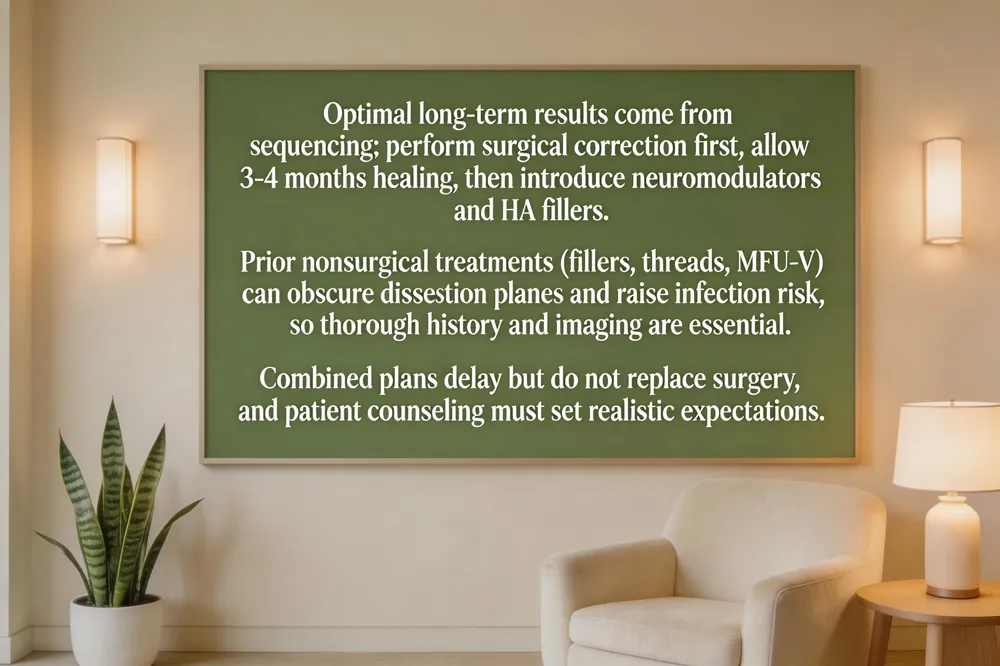 Sequencing surgery with injectable maintenance maximizes long‑term results. Most surgeons recommend performing a facelift or other anatomical correction first, allowing the tissues to heal for 3–4 months before introducing neuromodulators (e.g., Botox, Xeomin) and hyaluronic‑acid fillers. This timing lets the surgeon assess the new contour and prevents filler‑induced tension that could complicate scar placement or SMAS repositioning.
Prior nonsurgical treatments can affect later surgery. Residual hyaluronic‑acid, calcium‑hydroxylapatite or thread‑lift material may obscure dissection planes, increase the risk of uneven tissue planes, and elevate infection rates. A thorough history and imaging study are essential; many patients who have used micro‑focused ultrasound, MFU‑V, or biostimulation report a 47 % consideration of facelift and 44 % future interest, underscoring the need for early surgical counseling.
Patient counseling should set realistic goals, discuss the temporary nature of injectables (3–4 months for neuromodulators, 6–18 months for fillers), and outline how a combined plan can delay but not replace surgery.
Sculptra Indianapolis – Poly‑L‑lactic‑acid injections stimulate collagen for up to two years, restoring cheek and jawline volume.
Skin rejuvenation before and after – Baseline photos compare sun‑damaged, lax skin with post‑laser or peel results showing smoother texture and tighter tone within weeks.
Facial rejuvenation cost – Surgical facelifts average $9,600; non‑surgical sessions range $150‑$3,000.
Facial rejuvenation Indiana prices – Laser/peel $150‑$425 per session; microneedling $325; bundled packages $699‑$1,329.
How much does a face rejuvenation cost? – IPL $1,300; chemical peels $125‑$1,300; Morpheus8 $700‑$3,600; ablative CO₂ laser $4,000‑$8,500.
Practical Considerations: Financing, Safety, and After‑Care
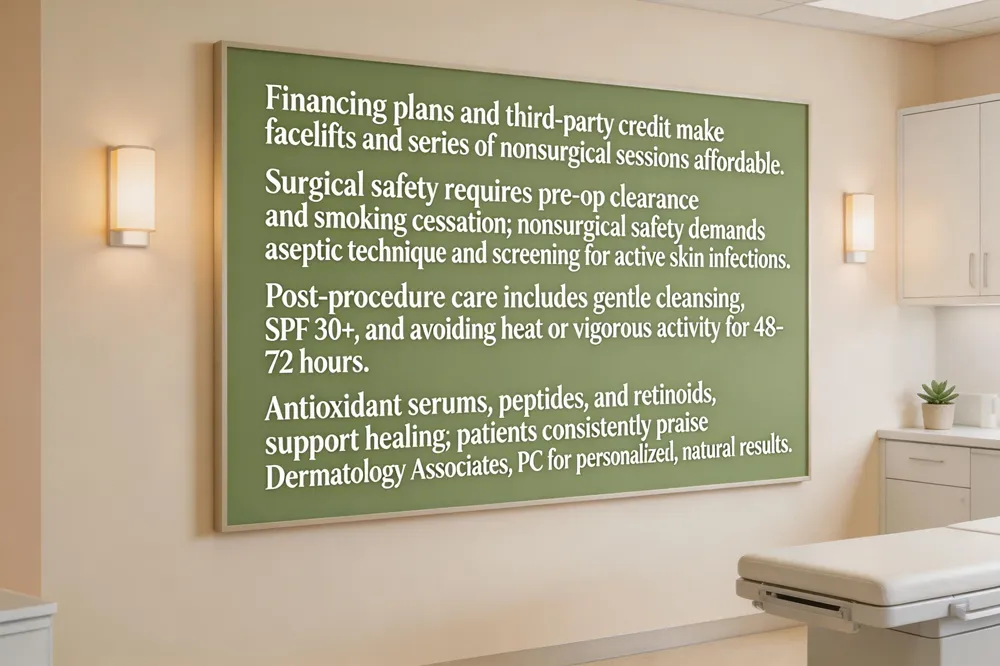 Financing and payment plans are essential for both surgical and nonsurgical rejuvenation. Many Indiana clinics, including Dermatology Associates, PC, offer flexible installment options and financing through third‑party providers, allowing patients to spread the cost of facelifts, laser resurfacing, or injectable series over time.
Safety guidelines differ by modality. Surgical procedures require pre‑operative health clearance, cessation of smoking two weeks prior, and monitoring for anesthesia‑related risks, while nonsurgical treatments such as Botox, hyaluronic‑acid fillers, micro‑focused ultrasound (MFU‑V), and laser resurfacing demand strict aseptic technique, screening for active skin infections, and adherence to FDA‑approved dosing.
Post‑procedure care focuses on gentle cleansing, broad‑spectrum SPF 30+, and avoidance of intense heat or vigorous exercise for the first 48‑72 hours. Follow‑up visits assess healing, manage bruising, and schedule maintenance injections or laser sessions.
Skin rejuvenation products: antioxidant serums (Vitamin C, peptide‑rich moisturizers, and retinol or glycolic‑acid exfoliators stimulate collagen and improve texture; Dermatology Associates tailors regimens to each patient’s skin type.
Facial rejuvenation Indiana reviews: patients praise the clinic’s personalized approach, natural results, and transparent communication throughout consultation, treatment, and recovery.
Best facial rejuvenation non‑surgical treatment: a customized blend of neuromodulators (Botox®/Dysport®) and hyaluronic‑acid fillers, often complemented by a fractional laser such as Halo® for texture and tone, provides immediate, natural‑looking rejuvenation without surgery.
Your Path to a Youthful, Confident You
Facial rejuvenation offers two broad pathways: surgical and non‑surgical. Surgical options such as a facelift, neck lift, blepharoplasty, or brow lift address deep sagging, jowls, and static wrinkles, delivering results that can last 7‑15 years but require anesthesia, incisions, and a recovery period of 1‑2 weeks. Modalities—including neuromodulators (Botox, Xeomin), hyaluronic‑acid fillers, laser resurfacing, microneedling, chemical peels, and ultrasound‑guided ultrasound—provide modest improvements with minimal downtime and lower immediate risk. Most patients begin with injectables or laser work and later transition to surgery when skin laxity progresses or long‑term durability is desired. The next step is a consultation with a board‑certified facial plastic surgeon or dermatologist who can assess your anatomy, health status, and aesthetic goals, then design a multimodal plan.