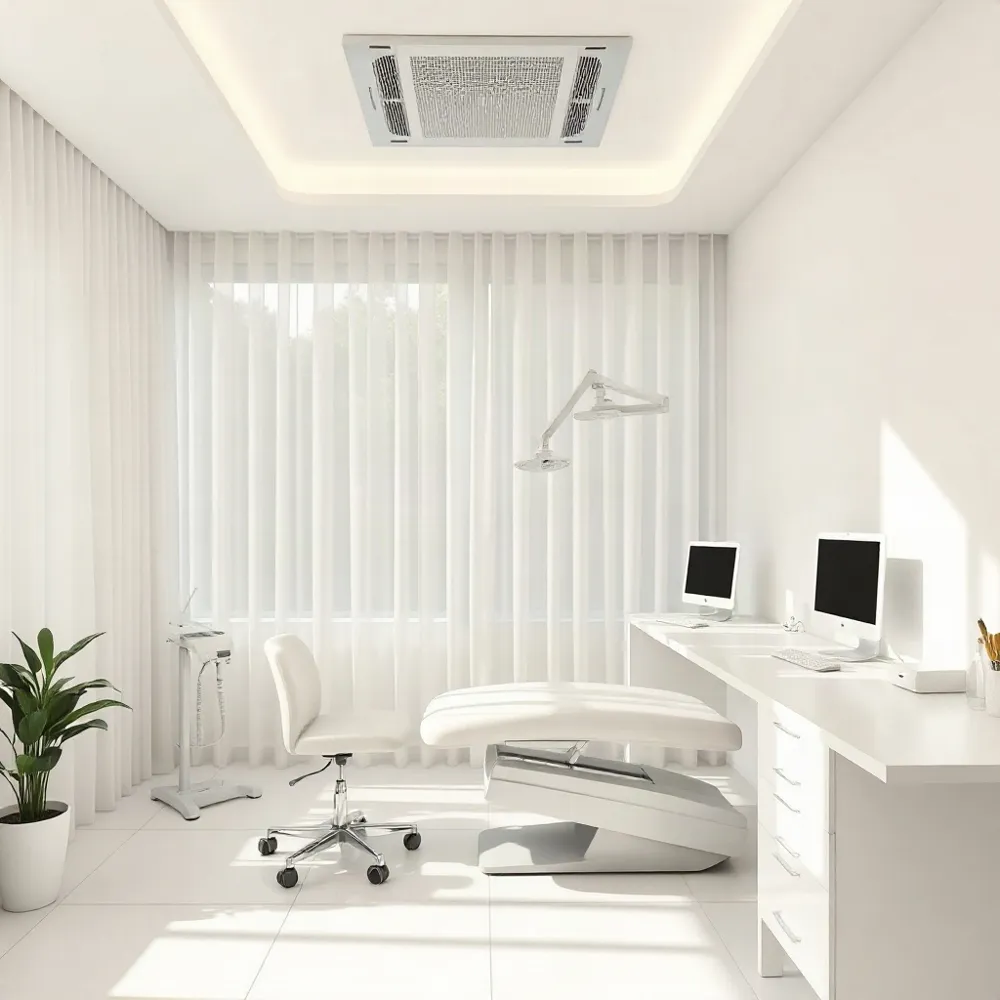
Personalized Rejuvenation Starts with Knowing Your Skin
Understanding your skin type—dry, oily, combination, sensitive or normal—is the foundation of effective facial rejuvenation. A comprehensive assessment, including Fitzpatrick classification, texture analysis and lifestyle review, lets board‑certified dermatologists at Dermatology Associates, PC tailor treatments safely. Options range from gentle, low‑energy lasers and enzyme peels for delicate skin, to deeper fractional resurfacing, microneedling‑PRP, radiofrequency and injectable neuromodulators or fillers for oily, mature or complex concerns. Individualized plans maximize results while minimizing irritation and downtime and long‑term skin health for you.
Understanding Skin Types and Their Unique Needs
Quick Reference Table
| Skin Type | Key Characteristics | Common Triggers | Typical Concerns |
|---|---|---|---|
| Oily | Excess sebum, shiny T‑zone, enlarged pores, blemishes | Hormonal fluctuations, high‑glycemic diet, humid climate, over‑cleansing | Acne, enlarged pores, shine |
| Dry | Tight, rough, flaky, dull appearance, easily irritated | Harsh cleansers, low humidity, aging skin | Flakiness, sensitivity, fine lines |
| Combination | Oily T‑zone, dry/normal cheeks | Same as oily + dry factors | Mixed texture, uneven hydration |
| Sensitive | Redness, itching, burning, reacts to irritants | Environmental pollutants, harsh ingredients, stress | Inflammation, barrier disruption |
AI‑driven imaging maps fine lines, sun damage, pore size, and texture to personalize treatment plans.
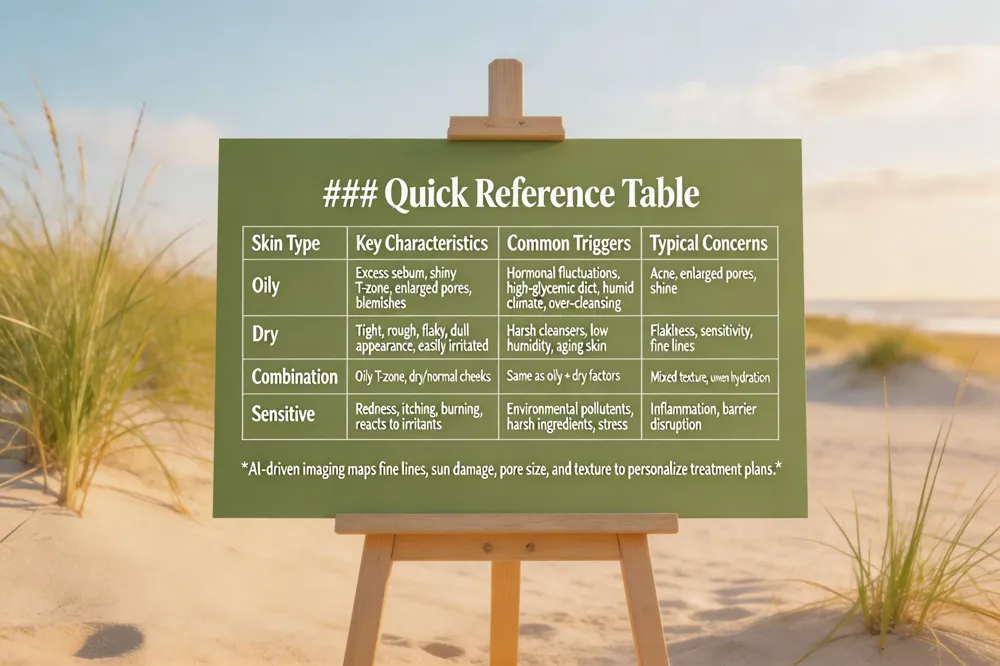 Facial rejuvenation begins with a clear picture of a patient’s skin type. The four main skin types are oily, dry, combination, and sensitive. Oily skin produces excess sebum, giving a shiny appearance—especially in the T‑zone—and is prone to enlarged pores and blemishes. Dry skin lacks moisture, feels tight or rough, and may appear dull or flaky, often becoming irritated by harsh products. Combination skin exhibits both oily areas (typically the T‑zone) and dry or normal patches on the cheeks. Sensitive skin reacts easily to environmental factors or skincare ingredients, showing redness, itching, or burning sensations.
Hormonal influences drive oily skin in females. Fluctuations in androgens during puberty, menstrual cycles, pregnancy, and menopause stimulate sebaceous glands to overproduce sebum. Genetics, stress‑induced cortisol spikes, humid climates, high‑glycemic diets, over‑cleansing, and certain medications (e.g., oral contraceptives or hormone replacement) further exacerbate oiliness.
A customized skin analysis tailors treatment to these nuances. AI‑driven imaging captures high‑resolution photos and uses machine‑learning to map fine lines, sun damage, pore size, and texture. The algorithm generates a personalized rejuvenation plan—selecting appropriate lasers, peels, microneedling, or injectables—while minimizing downtime and respecting the patient’s specific skin type and concerns.
Natural and At‑Home Strategies for Oily Skin
At‑Home Routine & Home Remedies
| Step | Product / Action | Purpose |
|---|---|---|
| Cleanse | Gentle water‑based or foaming pH‑balanced cleanser (twice daily) | Remove excess sebum without stripping barrier |
| Tone | Alcohol‑free toner | Balance pH, prep skin for actives |
| Treat | Niacinamide or salicylic acid serum | Regulate sebum, reduce inflammation |
| Moisturize | Oil‑free gel moisturizer with hyaluronic acid & ceramides | Hydrate without clogging pores |
| Protect | Broad‑spectrum SPF 30+ (gel/cream) | Prevent UV‑induced oil increase |
| Night | Retinoid or benzoyl‑peroxide (2‑3×/week) | Promote cell turnover |
| Mask (weekly) | French‑green clay, honey‑oatmeal, or egg‑white‑lemon paste (10 min) | Absorb oil, tighten pores |
| Remedy | Raw honey (10 min), diluted apple‑cider‑vinegar rinse, aloe‑vera gel | Soothe, antibacterial, maintain moisture |
Laser options (fractional non‑ablative, diode/picosecond) can further reduce gland activity when combined with gentle post‑care.
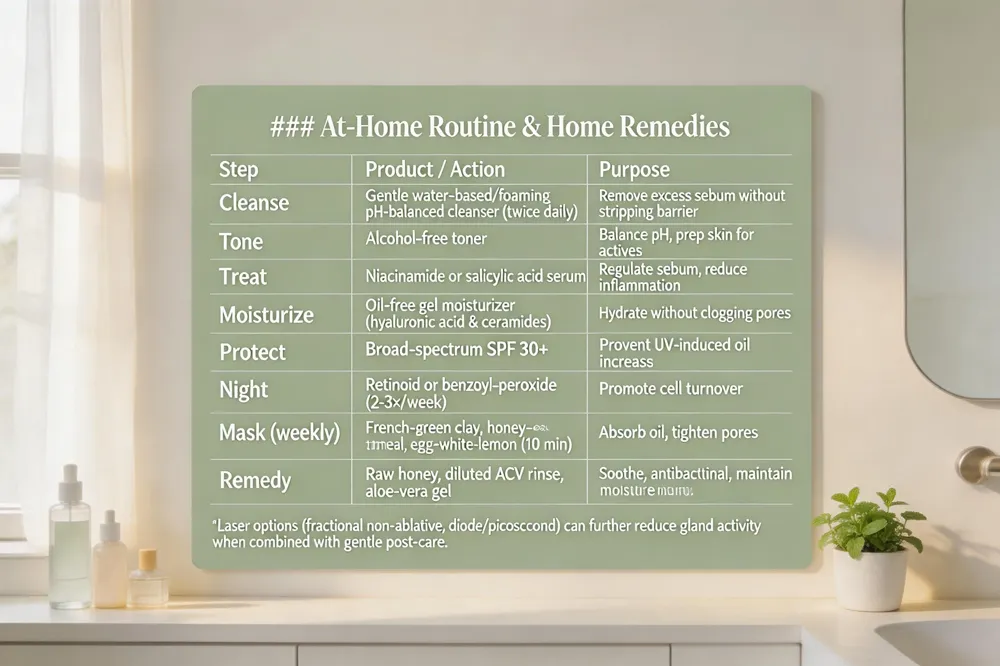 Oily skin can be tamed without harsh chemicals by starting with a gentle, water‑based cleanser used twice daily to lift excess sebum while preserving the barrier. Follow with a lightweight, oil‑free moisturizer or a niacinamide serum to rebalance production and keep hydration in check. Weekly absorbent masks—French‑green clay, honey, oatmeal or an egg‑white‑lemon paste—draw out oil, calm inflammation and tighten pores. A diet rich in low‑glycemic fruits, vegetables, whole grains, plenty of water and limited refined sugars supports stable sebum levels.
Dermatologist‑recommended daily steps begin with a foaming, pH‑balanced cleanser, an alcohol‑free toner, then a treatment serum containing niacinamide or salicylic acid. Hydrate with a gel‑based, non‑comedogenic moisturizer that includes hyaluronic acid and ceramides, and finish with a Broad‑spectrum SPF 30+ sunscreen formulated for oily skin. Nightly, incorporate a retinoid or benzoyl‑peroxide a few nights per week for cell turnover.
Effective home remedies for pimples include raw honey’s (10 min), diluted apple‑cider‑vinegar rinses, and aloe‑vera gel to soothe and prevent bacterial growth while maintaining moisture.
Laser options such as fractional non‑ablative lasers or diode/picosecond devices can reduce sebaceous gland activity and refine texture; results improve when paired with gentle post‑procedure care and consistent topical regimens.
Caring for Dry Skin: Home and Clinical Approaches
Dry Skin Care Checklist
| Aspect | Home Care | Clinical Options |
|---|---|---|
| Cleansing | Fragrance‑free, non‑foaming cleanser; short lukewarm showers | Prescription barrier‑repair cleansers |
| Moisturizing | Ceramide‑rich creams/ointments applied on damp skin; occlusive petrolatum at night | In‑office moisturizers with urea, hyaluronic acid, peptide‑rich formulas |
| Barrier Support | Humidifier in low‑humidity environments | Microneedling, gentle chemical peels, fractional laser resurfacing (low energy) |
| Targeted Masks | Oatmeal or avocado‑Greek‑yogurt mask; almond oil or shea‑butter seal | Professional hydrating peels, PRP‑enhanced treatments |
| Sun Protection | Broad‑spectrum SPF 30+ (cream/ointment) | Prescription‑strength sunscreen for photosensitive patients |
| Age‑Specific | For patients 60+: daily hyaluronic acid & ceramide moisturizers, low‑dose retinoids or bakuchiol, antioxidant serums | Periodic microneedling, gentle peels, fractional laser resurfacing |
Key tip: Apply moisturizers while skin is still damp to lock in hydration.
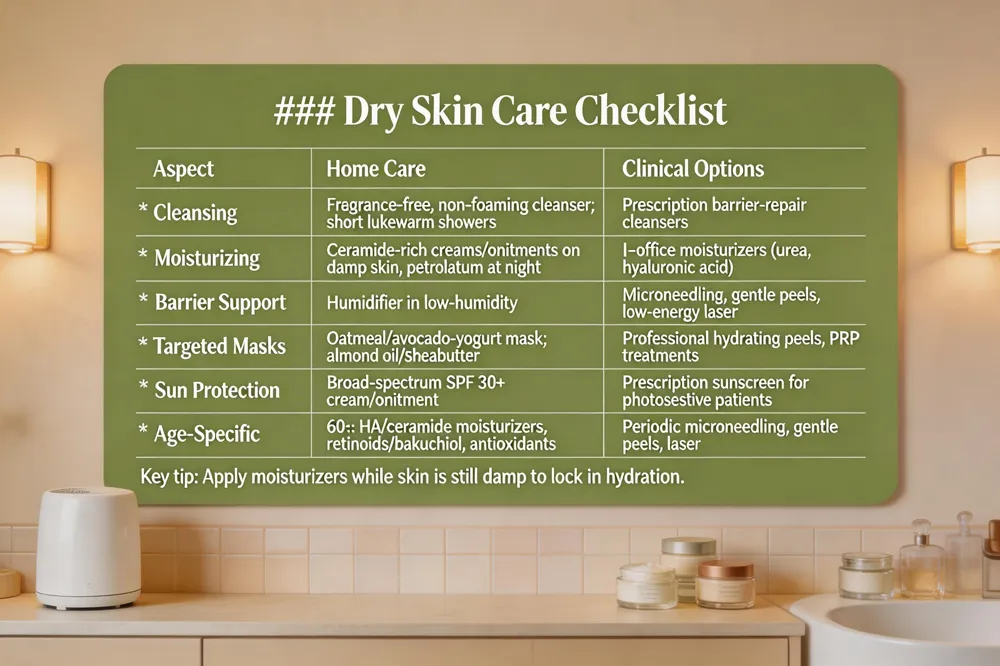 Dermatologists advise using fragrance‑free, ceramide‑rich moisturizers or ointments (e.g., thick creams, petrolatum) applied while the skin is still damp to lock in hydration. Gentle, non‑foaming cleansers and short, lukewarm showers prevent barrier stripping; in low‑humidity environments a humidifier adds ambient moisture.
Winter skin‑care should focus on brief, warm showers, immediate post‑bathe application of a rich occlusive moisturizer containing ceramides, urea, or hyaluronic acid, and overnight protection of hands, feet, and elbows with petroleum jelly or cotton gloves.
For facial dryness, start with a mild lukewarm cleanser, then soothe with an oatmeal or avocado‑Greek‑yogurt mask. Follow with a thin layer of aloe‑vera gel or a blend of olive oil and honey, and seal the barrier at night with a small amount of almond oil or a shea‑butter/olive‑oil mixture.
Leg dryness can be managed by cleansing with a fragrance‑free liquid, gentle weekly exfoliation, and immediate application of a thick moisturizer rich in urea, glycerin, or petrolatum. Wear breathable fabrics and avoid harsh soaps.
Patients over 60 benefit from daily fragrance‑free moisturizers with hyaluronic acid and ceramides, low‑dose retinoids or bakuchiol for collagen stimulation, peptide‑rich creams for firmness, antioxidant serums such as vitamin C, and consistent SPF 30+ sunscreen. Periodic in‑office microneedling, gentle chemical peels, or fractional laser resurfacing can enhance cellular turnover while preserving the delicate barrier.
Combination and Sensitive Skin: Balancing Hydration and Treatment
Dual‑Approach Treatment Matrix
| Region | Recommended Actives | Frequency | Goal |
|---|---|---|---|
| Oily T‑zone | Enzyme exfoliant or light chemical peel (AHA/BHA), niacinamide serum | 2‑3 ×/week | Reduce oil, minimize pores |
| Dry/Normal Cheeks | Hyaluronic‑acid filler or barrier‑repair serum, ceramide cream | Daily | Restore hydration, protect barrier |
| Sensitive Areas | Fragrance‑free anti‑inflammatory serums (oat extract, niacinamide) | Daily | Calm redness, prevent irritation |
| Whole Face (post‑procedure) | Broad‑spectrum SPF 30+, ceramide‑rich moisturizer | Daily | Maintain results, protect skin |
| Advanced Option | Low‑energy microneedling + PRP (combined) | Every 4‑6 weeks | Collagen boost, uniform texture |
| Energy‑Based | Non‑ablative laser or LED photobiomodulation | As per protocol | Improve elasticity, minimal downtime |
Balancing act: treat each zone with tailored actives while keeping the overall barrier intact.
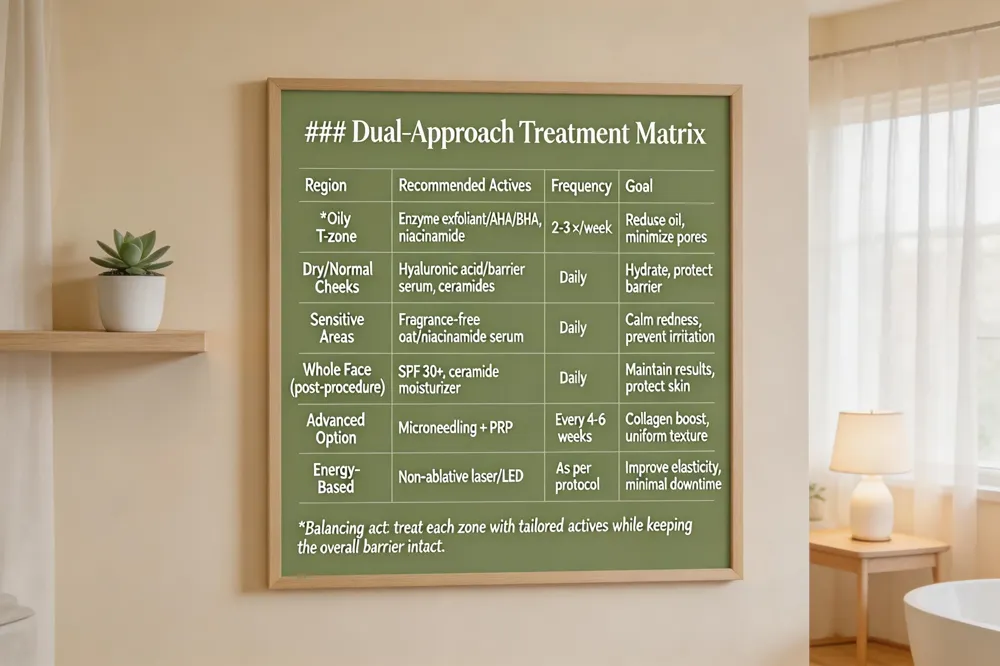 Patients with combination skin often have an oily T‑zone and drier peripheral areas, while sensitive skin reacts easily to irritation. A hybrid approach that targets each region individually—using targeted chemical peels or enzyme exfoliants on oily zones and barrier‑repair hyaluronic‑acid filler placements on dry patches—creates a balanced texture without over‑treating any area. Low‑energy microneedling combined with platelet‑rich plasma (PRP) is especially suited for both skin types: the microneedles stimulate collagen while the PRP delivers growth‑factor serums that lock in moisture and calm inflammation. For sensitive skin, soothing modalities such as fragrance‑free, anti‑inflammatory serums (niacinamide, oat extract) and non‑ablative laser or LED‑guided photobiomodulation provide rejuvenation with minimal downtime. These gentle energy‑based treatments improve elasticity and tone while preserving the skin barrier, making them ideal for patients who need both hydration and precise resurfacing. Consistent post‑procedure care—broad‑spectrum SPF 30+, ceramide‑rich moisturizers, and avoidance of harsh actives—ensures lasting results across mixed and delicate skin types.
Professional Rejuvenation Options Across All Skin Types
Professional Modalities Overview
| Modality | Skin Types Suited | Mechanism | Typical Downtime |
|---|---|---|---|
| Fractional Non‑Ablative RF / MOXI™ / CO₂ | All (adjusted for Fitzpatrick) | Heat‑induced collagen remodeling | 1‑2 days mild redness |
| IPL / Non‑Ablative Laser | Oily/acne‑prone, lighter tones | Pore reduction, sebum regulation | 1 day redness |
| Chemical Peels | • Superficial AHA (dry/sensitive) <br>• Medium salicylic/glycolic (oily) <br>• Deep TCA/Phenol (mature) | Controlled epidermal exfoliation | 2‑7 days depending on depth |
| Injectables | All | Neuromodulators (Botox/Dysport) relax dynamic lines; HA fillers restore volume | Minimal, <24 hrs swelling |
| Microneedling + PRP | All | Micro‑injuries stimulate collagen; PRP adds growth factors | 1‑3 days redness |
| Laser Resurfacing | All (energy adjusted) | Ablative removal of damaged layers | 3‑10 days depending on intensity |
Cost reference (US): Peels $150‑$350, light laser $800‑$2,500, fractional/ablative laser $500‑$5,000+, fillers $500‑$950 per syringe, neuromodulators $10‑$15 per unit.
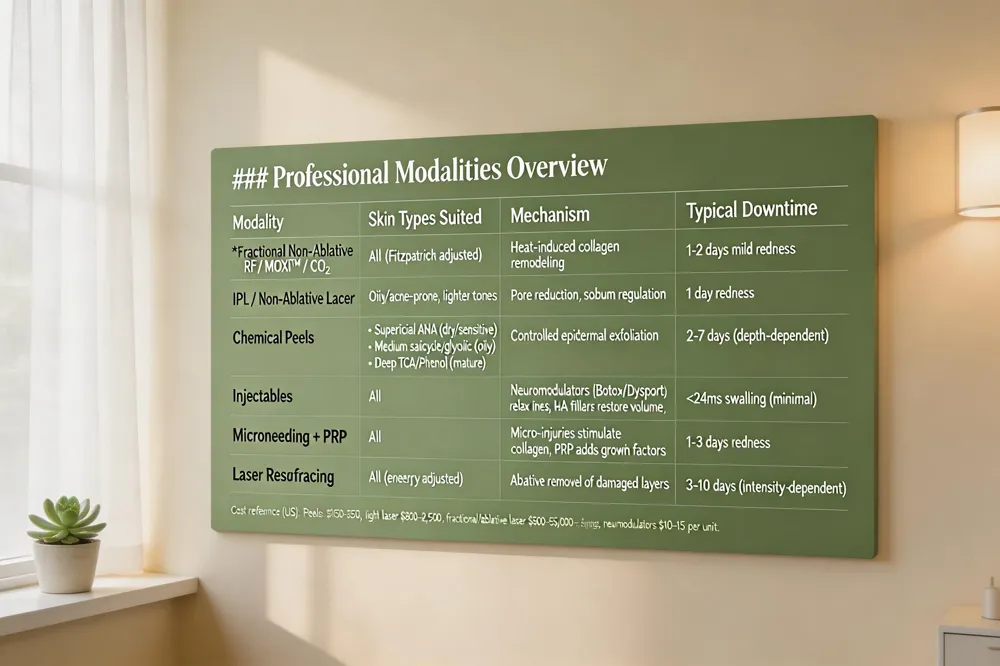 Laser and light technologies such as fractional non‑ablative radiofrequency, MOXI™ and CO₂ fractional lasers can be calibrated for each Fitzpatrick skin type, delivering collagen‑stimulating heat without excessive downtime. For oily or acne‑prone skin, non‑ablative lasers and IPL improve pore size and sebum regulation, while darker tones benefit from lower‑energy settings to prevent post‑inflammatory hyperpigmentation.
Chemical peels are selected by depth and acidity: superficial AHA peels (glycolic or lactic) are gentle for dry or sensitive skin; medium‑strength salicylic or glycolic peels target oily zones and acne, and deeper TCA or phenol peels are reserved for mature, textured skin when pre‑and post‑care protocols are in place.
Injectables include neuromodulators (Botox, Dysport) that safely relax dynamic lines across all skin types, and hyaluronic‑acid fillers of varying viscosity to restore volume without compromising barrier function. Microneedling combined with PRP enhances collagen remodeling for every skin type.
What is the best treatment for dry, aging skin? A comprehensive plan blends barrier‑repair moisturizers rich in ceramides and hyaluronic acid, daily broad‑spectrum SPF, a retinol or bakuchiol regimen, and periodic in‑office hydrating peels or low‑energy laser resurfacing to boost collagen while preserving moisture.
What does a facial rejuvenation procedure cost at a dermatology clinic? Costs vary: chemical peels $150‑$350, light laser resurfacing $800‑$2,500, fractional/ablative laser $500‑$5,000+, fillers $500‑$950 per syringe, neuromodulators $10‑$15 per unit. Prices include provider fees, facility use, and after‑care products; financing options are often available. A personalized consult at Dermatology Associates, PC provides an exact quote tailored to your skin type and goals.
Patient Success Stories and Personalized Care at Dermatology Associates, PC
Jane’s Combination‑Skin Journey (Case Study)
| Phase | Treatment | Frequency | Outcome |
|---|---|---|---|
| Initial Assessment | AI‑driven imaging, texture & oil mapping | 1 visit | Baseline data for personalized plan |
| Quarterly Light Peels | Superficial AHA + targeted BHA on T‑zone | Every 3 months | 30 % reduction in fine lines, smoother texture |
| Targeted HA Fillers | Hyaluronic‑acid filler in dry cheek zones | Single session | Restored volume, balanced hydration |
| PRP Session | Platelet‑rich plasma microneedling | One session | Enhanced collagen, uniform tone |
| After‑Care | Gentle cleanser, ceramide moisturizer, SPF 30+ sunscreen | Daily | Sustained results, minimal irritation |
Key takeaway: Personalized skin assessments + evidence‑based protocols deliver safe, effective rejuvenation across all skin types.
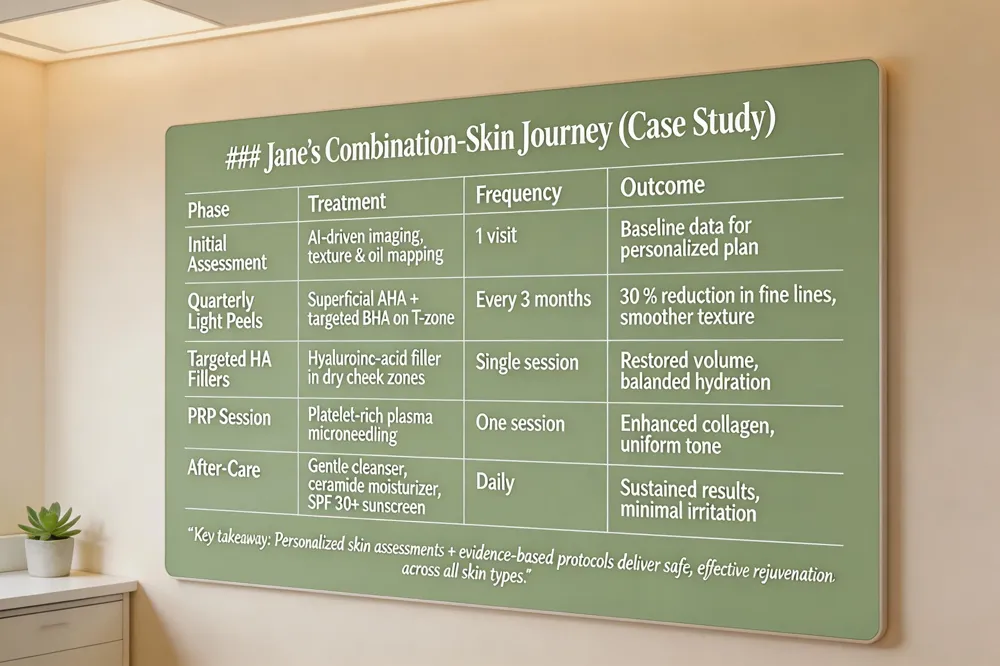 Jane, a 42‑year‑old with combination skin, illustrates the power of a customized rejuvenation plan. After a series of quarterly light peels, targeted hyaluronic‑acid filler placements in the dry zones, and a single platelet‑rich plasma (PRP) session, she achieved a 30 % reduction in fine lines and markedly smoother texture—all overseen by Dr. Maya Patel. This outcome stems from Dermatology Associates, PC’s comprehensive skin assessments, which evaluate texture, oil distribution, sensitivity, lifestyle factors, and Fitzpatrick type before any procedure. The practice emphasizes patient education, providing clear pre‑ and post‑treatment protocols—such as gentle cleansing, barrier‑repair moisturizers, and daily SPF 30+ sunscreen—to sustain results and minimize complications. By integrating evidence‑based treatments like microneedling, radiofrequency, and laser technologies with personalized after‑care guidance, the clinic ensures safe, effective rejuvenation for every skin type.
Your Path to Radiant, Healthy Skin
Choosing the right rejuvenation starts with matching each skin type—dry, oily, combination, sensitive—to proven modalities such as hydrating microneedling‑PRP for dry skin, salicylic‑acid peels for oily zones, and low‑energy fractional lasers for sensitivity. Even after a procedure, lasting results depend on diligent after‑care: daily broad‑spectrum SPF 30+ sunscreen, barrier‑repair moisturizers, and antioxidant serums to protect against UV‑induced aging. Ready for a plan built around your unique skin? Call (555) 123‑4567 or visit our website to book a private, personalized consultation.