Understanding Laser Hair Removal
Laser hair removal relies on selective photothermolysis, where a laser’s wavelength is absorbed by melanin in the hair follicle and converted to heat that damages the follicle. The Fitzpatrick scale (Types I‑VI) guides safe laser selection: shorter‑wavelength lasers (Alexandrite 755 nm) work best on light to olive skin (Types I‑III), while longer‑wavelength devices (Nd:YAG 1064 nm) are safest for darker skin (Types IV‑VI) because they bypass epidermal melanin. Efficacy is greatest when there is high contrast between dark hair and light skin, allowing maximal energy absorption by the follicle. Hair grows in cycles; only hairs in the anagen (growth) phase contain sufficient melanin for effective treatment, which is why multiple sessions are required to capture the 10‑20 % of hairs in this phase at any time. Pre‑treatment preparation includes avoiding sun exposure for at least two weeks, shaving (not waxing) the area, and discontinuing retinoids or acids five days prior. Post‑treatment care advises avoiding heat for 48 hours, applying SPF 30+ sunscreen, and using soothing agents such as aloe vera to mitigate transient redness or irritation.
Matching Laser Technology to Skin and Hair Type
Matching Laser Technology to Skin and Hair Type
| Laser Device | Wavelength (nm) | Fitzpatrick Types | Ideal Hair Type | Key Points |
|---|---|---|---|---|
| Alexandrite | 755 | I‑III | Dark, coarse | High melanin absorption; rapid reduction; minimal epidermal damage on light skin |
| Diode | 800‑810 | II‑IV | Medium‑to‑dark, coarse | Deeper penetration; broader safety margin; good for medium skin tones |
| Nd:YAG | 1064 | IV‑VI | Coarse | Bypasses surface melanin; reduces burns & hyper‑pigmentation on darker skin |
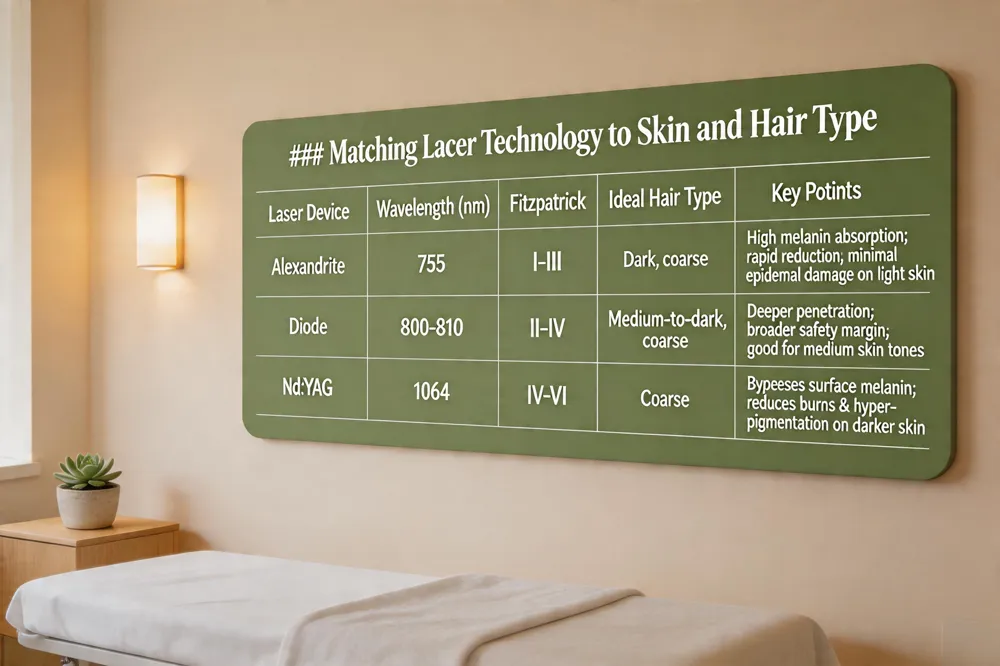 Fitzpatrick scale (I‑VI) is the cornerstone for selecting a safe, effective laser. Light‑to‑olive skin (Types I‑III) tolerates shorter wavelengths—Alexandrite (755 nm) and Diode (800‑810 nm)—which are highly absorbed by melanin, delivering rapid hair‑reduction with minimal epidermal damage. Darker skin (Types IV‑VI) requires longer‑wavelength devices such as Nd:YAG (1064 nm) that bypass surface melanin, reducing burns and hyper‑pigmentation.
Higher contrast between dark hair and light skin yields better results because the laser’s energy is preferentially absorbed by hair follicle melanin while sparing surrounding tissue. This principle explains why patients with dark, coarse hair on fair skin achieve 80‑85 % reduction in fewer sessions.
Ideal candidates per wavelength:
- Alexandrite: Fitzpatrick I‑III, dark coarse hair.
- Diode: Fitzpatrick II‑IV, medium‑to‑dark skin, coarse hair.
- Nd:YAG: Fitzpatrick IV‑VI, darker skin, coarse hair.
What is the ideal skin type for laser hair removal? The most favorable candidates are individuals with light skin (Fitzpatrick I‑III) and dark, coarse hair, because the high contrast allows the laser to target the follicle efficiently while minimizing skin damage. For darker skin (Fitzpatrick IV‑VI), Nd:YAG or calibrated diode lasers provide safe, effective reduction when proper cooling and lower fluence are used.
Best Laser for Darker Skin Tones (Including Asian Skin)
Best Laser for Darker Skin Tones (Including Asian Skin)
| Laser | Wavelength (nm) | Target Skin Types | Safety Features | Typical Protocol |
|---|---|---|---|---|
| Nd:YAG | 1064 | IV‑VI (including Asian) | Long wavelength bypasses epidermal melanin; cooling (sapphire tip or spray) | Test‑spot → 6‑8 sessions spaced 4‑6 weeks; cooling each session |
| Dual‑Wavelength (Nd:YAG + Alexandrite) | 1064 / 755 | IV‑VI (Nd:YAG) & I‑III (Alexandrite) | Mode selection per area; built‑in cooling | Use Nd:YAG for darker zones, switch to Alexandrite for lighter contrast zones |
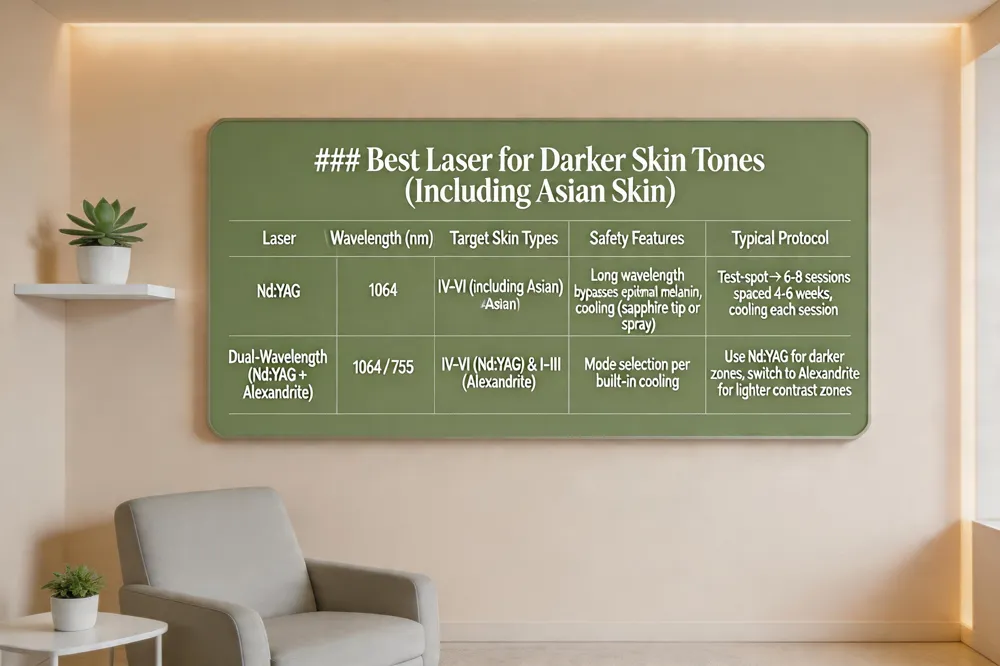 Nd:YAG lasers (1064 nm) are the safest choice for Fitzpatrick IV‑VI skin, including many Asian skin types, because the longer wavelength bypasses epidermal melanin, reducing burns, hyper‑ and hypopigmentation while still delivering sufficient heat to the follicle. A typical protocol starts with a test‑spot on a small area to confirm tolerance, followed by a series of 6‑8 sessions spaced 4‑6 weeks apart, each session using a cooling method such as a chilled sapphire tip or contact spray to protect the epidermis and improve comfort.
Dual‑wavelength platforms—e.g., Nd:YAG combined with Alexandrite (Candela GentleMax Pro, Cynosure Apogee Elite)—allow the clinician to select Nd:YAG for darker skin and switch to Alexandrite for lighter,Treat‑contrast zones, expanding treatment versatility while maintaining safety.
Which laser hair‑removal method is best for Asian skin? For patients with darker Asian skin, the Nd:YAG laser is generally the most effective and safest option. Its deep penetration avoids surface melanin, minimizing pigmentary side‑effects. Dual‑wavelength systems enable the Nd:YAG mode for Asian skin and reserve Alexandrite for lighter areas. A test spot, proper cooling, and strict sun‑protection protocols further reduce risks, yielding about 80 % hair reduction after a full series.
Comparing Alexandrite and Diode Lasers
Comparing Alexandrite and Diode Lasers
| Laser | Wavelength (nm) | Fitzpatrick Range | Advantages | Disadvantages |
|---|---|---|---|---|
| Alexandrite | 755 | I‑III | Strong melanin absorption; larger spot size → fewer passes; fast coverage of large areas | Higher erythema & hyper‑pigmentation risk in darker skin |
| Diode | 800‑810 | II‑IV | Deeper penetration; less melanin absorption → broader safety margin; milder side‑effects | Slightly slower coverage; may require more passes per session |
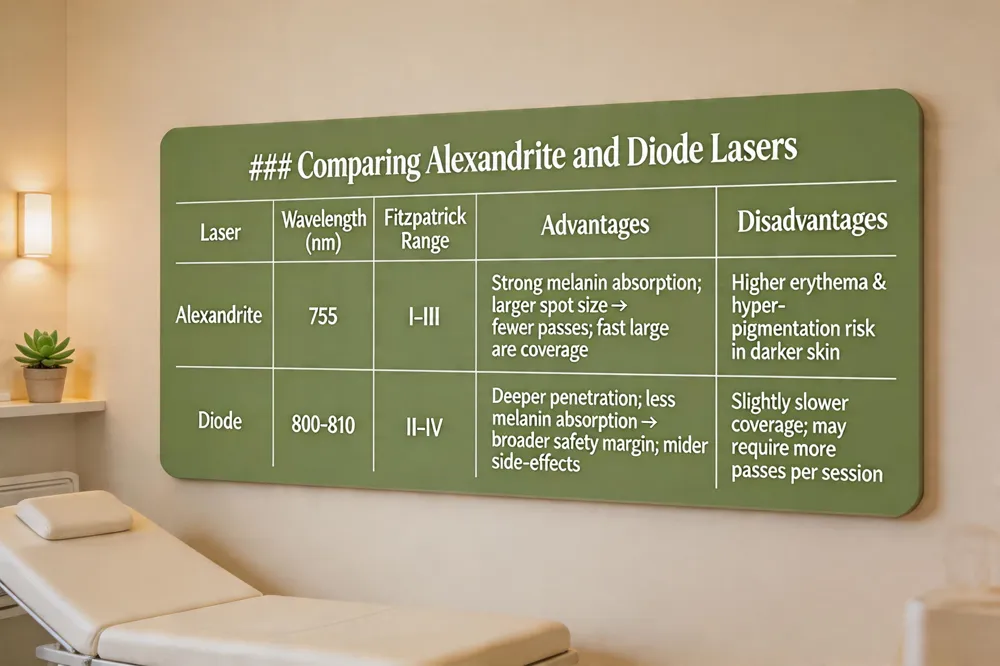 The Alexandrite laser operates at 755 nm, a shorter wavelength that is highly absorbed by melanin, delivering rapid, high‑energy pulses ideal for Fitzpatrick Types I‑III (light‑to‑medium skin) and dark, coarse hair. Diode lasers emit 800‑810 nm light, offering deeper penetration with less melanin absorption, which broadens safety for Types II‑IV (medium to dark) and reduces the risk of pigment alteration. Clinically, both systems achieve 70‑90 % permanent‑hair‑reduction after a full series, but Alexandrite’s larger spot size often requires fewer passes per session, whereas diode’s versatility makes it the “workhorse” for diverse skin tones. Side‑effect profiles reflect these physics: Alexandrite can cause more transient erythema or hyper‑pigmentation in darker skin, while diode treatments are generally milder and better tolerated, especially with cooling caps.
How does Alexandrite laser compare to diode laser for hair removal? The Alexandrite laser (755 nm) emits a shorter wavelength that is strongly absorbed by melanin, making it highly effective for light‑to‑medium skin tones and allowing rapid coverage of large areas such as the back or legs. The diode laser (800‑810 nm) penetrates deeper into the follicle and is less absorbed by epidermal melanin, which gives it a broader safety margin for medium to dark skin types and reduces the risk of pigment changes. Both systems achieve permanent‑hair‑reduction rates of 70‑90 % when a full treatment course is completed, but the Alexandrite typically requires fewer passes per session because of its larger spot size and faster pulse repetition. Patients with darker skin may experience more discomfort or temporary hyper‑pigmentation with Alexandrite, whereas diode treatments are generally perceived as milder. At Dermatology Associates, PC we tailor the choice of laser to each patient’s skin type, hair color and treatment goals to ensure optimal results and a comfortable experience.
Laser Options for Hyperpigmentation
Laser Options for Hyperpigmentation
| Treatment | Mechanism | Ideal Indications | Downtime | Risks |
|---|---|---|---|---|
| IPL (Intense Pulsed Light) | Broad‑spectrum light absorbed by superficial melanin | Mild sun spots, melasma, post‑inflammatory pigmentation | Minimal | Transient erythema, possible pigment rebound |
| CO₂ Laser | Ablative removal of epidermal/dermal layers | Deep, stubborn brown/black spots, scarring | 1‑2 weeks | Redness, swelling, higher pigment‑change risk in darker skin |
| Picosecond Laser | Ultra‑short pulses fragment pigment particles | All pigment types, especially refractory melasma | Minimal | Temporary erythema, occasional pinpoint crusting |
| Fractional Non‑Ablative (Thulium/Erbium‑Glass) | Micro‑columns treat deeper pigment while preserving tissue | Mixed superficial & deep pigment, texture improvement | 3‑5 days | Mild edema, temporary discoloration |
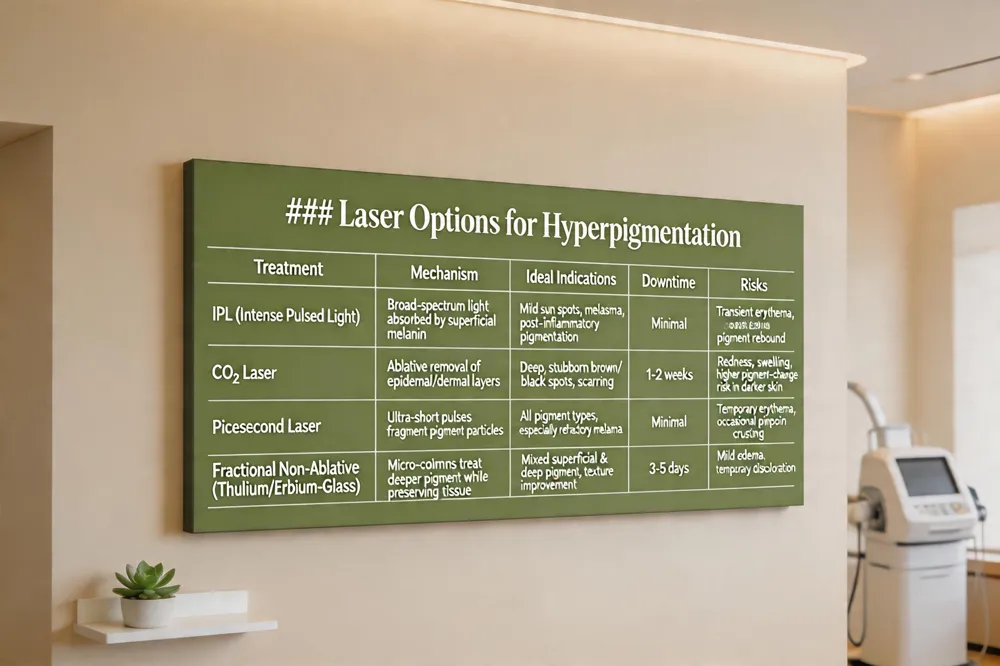 Is IPL or CO₂ laser better for treating hyperpigmentation? Both Intense Pulsed Light (IPL) and CO₂ lasers can improve hyperpigmentation, but they excel in different scenarios. IPL delivers a broad‑spectrum light that is absorbed by superficial melanin, making it ideal for mild, uneven sun spots, melasma, or post‑inflammatory pigmentation with minimal downtime. CO₂ laser penetrates deeper into the dermis and removes layers of damaged skin, so it is more effective for pronounced, stubborn brown or black spots and for patients who also have scarring. Because CO₂ laser is more aggressive, it carries a higher risk of post‑treatment redness and requires a longer recovery period, especially for darker skin tones. The choice should be personalized after a thorough evaluation by a board‑certified dermatologist.
What are the latest advancements in laser treatments for hyperpigmentation? Recent advances focus on precision energy delivery while minimizing thermal injury. Picosecond lasers generate ultra‑short pulses that fragment pigment particles at a microscopic level, allowing faster clearance of melasma, sun spots, and post‑inflammatory marks with fewer sessions and reduced downtime. Fractional non‑ablative lasers (e.g., fractional thulium or erbium‑glass) create micro‑columns of treatment that target deeper pigment layers while preserving surrounding tissue, improving skin texture. Hybrid protocols that combine fractional laser resurfacing with IPL or low‑fluence Q‑switched lasers address both surface irregularities and deeper discoloration in a single plan. AI‑guided skin mapping and customized wavelength selection further tailor each session to the patient’s specific pigment type and skin tone, enhancing efficacy and safety.
Safety and Medical Considerations
Safety and Medical Considerations
| Condition / Medication | Effect on Treatment | Adjustments Needed |
|---|---|---|
| Hashimoto’s disease (well‑controlled) | May cause dry, itchy skin → increased sensitivity | Lower fluence, extra cooling, monitor healing |
| Ozempic (semaglutide) | Possible mild dryness/healing delay | Patch test, adjust fluence, advise post‑care moisturizers |
| Active infection / recent isotretinoin | Impaired healing, risk of scarring | Defer treatment until resolved |
| Photosensitivity meds | Heightened risk of pigment changes | Avoid laser, use protective measures, schedule after drug clearance |
| Recent sun exposure, waxing, topical irritants | Increases risk of burns/PIH | Require 2‑weeks sun‑free period, shave 24‑48 h prior, discontinue irritants |
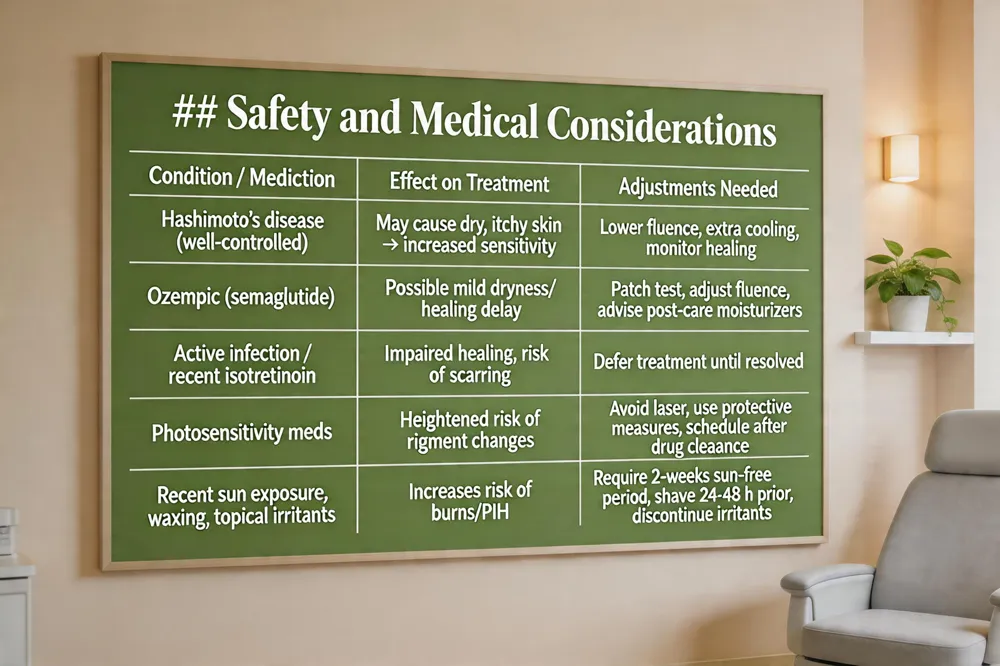 Hashimoto’s disease is not a direct contraindication for laser hair removal, but thyroid‑related skin changes (dryness, itching, inflammation) can increase sensitivity and affect healing. Our dermatologists will assess your skin and medication regimen, adjust fluence, and apply additional cooling if needed to minimize irritation. Well‑controlled hypothyroidism generally permits safe treatment with personalized settings. Ozempic (semaglutide) does not prohibit laser hair removal, though GLP‑1 therapy may cause mild skin dryness or altered healing. Informing the provider allows the clinician to evaluate skin condition, modify laser parameters, and give tailored post‑care instructions to reduce redness or discomfort. General contraindications include active infections, recent isotretinoin use, photosensitivity, and certain medications that impair healing. Pre‑treatment checks involve a skin‑type assessment (Fitzpatrick scale), review of medical history, patch testing, and ensuring no recent sun exposure, waxing, or topical irritants. Meeting these criteria helps achieve effective, safe hair reduction.
At‑Home Laser Hair Removal: What Works Best
At‑Home Laser Hair Removal: What Works Best
| Device Type | Wavelength (nm) | Best For Skin Types | Recommended Use | Safety Tips |
|---|---|---|---|---|
| Diode (home) | 800‑810 | II‑IV (medium‑to‑dark) | Facial hair, body hair | Perform patch test, start low, use built‑in skin‑tone sensor, cool skin before/after |
| IPL (home) | 500‑1200 (broad) | I‑III (light) | Large body areas with dark hair | Avoid on darker skin, ensure hair contrast, protect eyes, follow manufacturer intensity schedule |
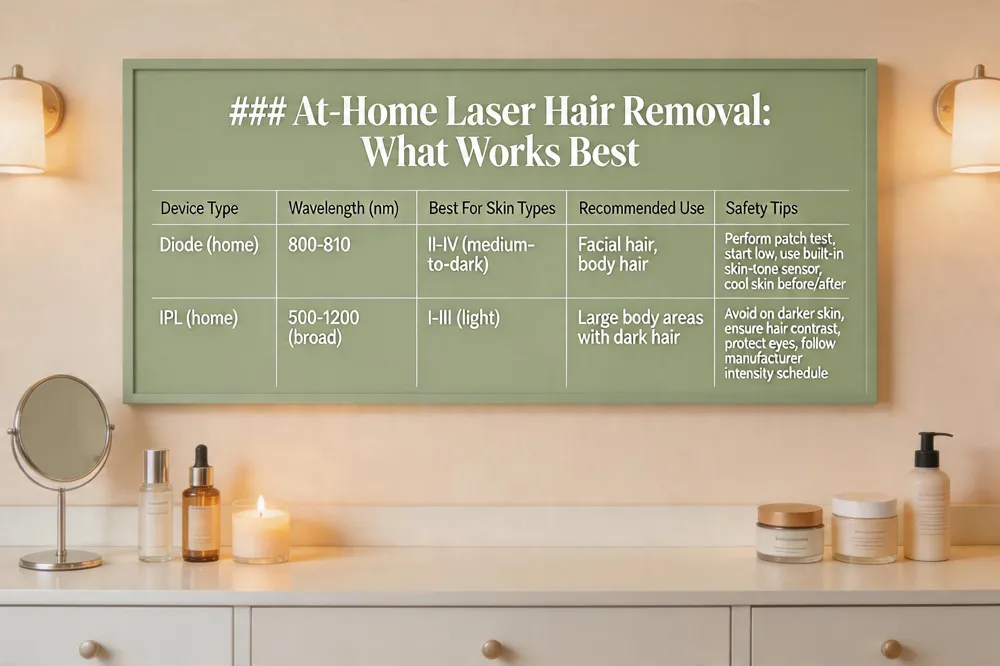 When choosing an at‑home system, diode lasers (800‑810 nm) outperform IPL for facial hair because their single wavelength delivers deeper, more targeted melanin absorption, reducing the number of sessions needed for visible thinning. IPL’s broad spectrum works only on light‑to‑medium skin with dark hair and often requires longer treatment periods. Modern diode devices now include skin‑tone sensors that automatically adjust fluence to the user’s Fitzpatrick type, minimizing the risk of burns or pigment changes. Integrated cooling—whether a sapphire tip, gel, or fan—keeps the epidermis comfortable and further protects against thermal injury. For facial hair, shave the area 24‑48 hours before treatment, perform a patch test, and follow the manufacturer’s recommended intensity levels, beginning low and increasing gradually. Apply SPF 30+ sunscreen daily and avoid sun exposure for at least two weeks before and after sessions. Consistent weekly use as per the device’s protocol typically yields noticeable reduction within three to four months.
Professional Practice Essentials
Professional Practice Essentials
| System | Wavelength (nm) | Primary Use | Typical Cost per Session (USD) | Notes |
|---|---|---|---|---|
| Nd:YAG | 1064 | Dark skin (IV‑VI) hair removal | 300‑500 (full leg) | Safe for Asian skin, requires cooling |
| Diode | 800‑810 | Versatile hair removal across many tones | 250‑450 (full leg) | High‑volume workhorse |
| Alexandrite | 755 | Light skin (I‑III) hair removal | 350‑550 (full leg) | Large spot size, fast coverage |
| IPL | 500‑1200 (broad) | Hair removal + cosmetic skin concerns | 150‑300 (full leg) | Useful for melasma, sun spots |
| Fractional CO₂ | 10600 | Resurfacing, scarring, deep pigment | 400‑700 (face) | Often combined with hair‑removal protocols |
 Top Clinical Laser Systems
The most widely‑used professional laser hair‑removal systems in dermatology practices are:
- Nd:YAG lasers – 1064 nm wavelength, safe for Fitzpatrick IV‑VI skins, deep penetration with minimal epidermal melanin absorption.
- Diode lasers (≈800–810 nm) – versatile, high‑volume, effective on a broad range of skin tones and coarse hair.
- Alexandrite lasers (755 nm) – high melanin absorption, ideal for Fitzpatrick I‑III skin and dark fine hair.
- Intense Pulsed Light (IPL) devices – broadband source useful for hair removal and other cosmetic concerns.
- Fractional CO₂ lasers – primarily for resurfacing but can complement hair‑removal protocols.
Cost Structure at Dermatology Associates, PC
Pricing varies by area and laser type. Full‑leg sessions run $300‑$500; upper‑lip treatments $50‑$100 per visit. The practice offers multi‑session package discounts and may apply insurance for medical indications (e.g., hormonal hair excess). A $100 deposit secures the appointment; payments are accepted online, by card, or via a payment‑plan on request. Patients should verify insurance benefits with billing staff before scheduling.
Patient Education & Treatment Planning
Patients receive a pre‑treatment consultation that assesses Fitzpatrick skin type, hair color, and growth cycle, followed by a patch test. Shaving 24‑48 hours before, avoiding sun exposure, and discontinuing retinoids five days prior are required. Post‑treatment care includes SPF 30+ sunscreen, avoiding heat for 48 hours, and soothing agents for redness. Treatment courses typically consist of 6‑8 sessions spaced 4‑6 weeks apart to target hairs in the anagen phase, with occasional maintenance sessions as needed.
Your Path to Safe, Effective Hair Removal
Choosing the right laser begins with a thorough assessment of the patient’s Fitzpatrick skin type, hair color, and thickness. Light skin (Types I‑III) with dark, coarse hair responds best to 755 nm Alexandrite or 800‑810 nm diode systems, whereas darker skin (Types IV‑VI) benefits from the 1064 nm Nd:YAG, which penetrates deeper and spares epidermal melanin, reducing hyper‑pigmentation risk. A board‑certified dermatologist evaluates medical history, recent retinoid use, and any contraindications before selecting fluence, pulse duration, and cooling method, and provides a patch test to confirm tolerance. Follow‑up visits allow fine‑tuning of settings, monitoring of side effects such as transient erythema, and documentation of hair‑reduction progress. Because only hairs in the anagen phase respond, a series of 6‑8 sessions spaced 4‑6 weeks apart is typical; occasional maintenance treatments every 6‑12 months sustain results. Patients should expect up to 80‑85 % reduction, with regrowth that is finer and lighter, and understand that lifelong periodic touch‑ups may be required for optimal, lasting smoothness and continued skin health monitoring.