A Modern Approach to Body Contouring
Non‑invasive body contouring reshapes localized fat deposits without incisions, anesthesia, or tissue removal. The FDA has cleared several device‑based modalities: cryolipolysis (controlled cooling to induce adipocyte apoptosis), radiofrequency (sub‑dermal heating that damages fat cells and stimulates collagen remodeling), light‑based energy (infrared lasers or IPL that thermally disrupt adipocytes), therapeutic ultrasound (focused acoustic waves that mechanically rupture fat cells), low‑level light therapy (non‑thermal photobiomodulation), pulsed magnetic fields (muscle‑toning contractions), and mechanical massage/vibration (enhanced lymphatic drainage). Patients should expect gradual results—typically 2‑4 months for full effect—with multiple sessions often needed. Safety considerations include disclosing implants, tattoos, medications, and medical conditions; common side effects are mild redness, swelling, or bruising, while rare complications such as paradoxical adipose hyperplasia or burns require prompt medical attention.
Cryolipolysis: The Gold Standard for Fat Freezing
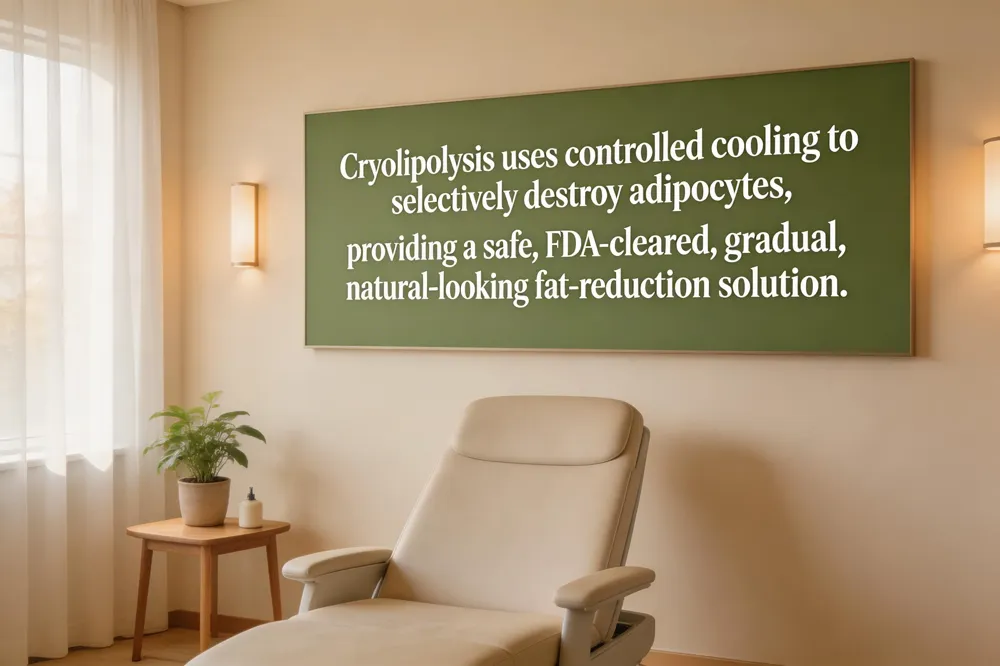 Cryolipolysis works by applying controlled cooling to subcutaneous adipose tissue; adipocytes are more cold‑sensitive than surrounding water‑rich cells, so they undergo apoptosis while skin, nerves and vessels remain unharmed.(FDA‑cleared devices)
The FDA has cleared devices under product code OOK (e.g., CoolSculpting) for areas such as the abdomen, flanks, thighs, back (bra rolls), upper arms, under‑buttock and chin.(FDA‑cleared devices
Patients typically notice a faint contour change within the first month, with maximal reduction – ‑‑3 % after 2‑3 months as the body metabolizes the dead cells.
Common side effects are mild and transient—redness, swelling, bruising, tingling, or temporary nodules.(Common side effects
Rare but serious adverse events include numbness, freeze burns, hernia formation, and paradoxical adipose hyperplasia (PAH), which can require surgical correction.(Paradoxical adipose hyperplasia (PAH)
What is the best non‑surgical procedure for fat removal? Cryolipolysis, often called “fat‑freezing,” is currently regarded as the most effective non‑surgical option for targeted fat reduction.(Cryolipolysis It uses a vacuum‑assisted applicator that cools tissue to a temperature that selectively destroys fat cells while sparing surrounding skin and nerves. The treatment is FDA‑cleared, has a well‑documented safety profile, and produces gradual, natural‑looking contour improvement without incisions or anesthesia.(FDA‑cleared Other technologies—radiofrequency, HIFU, laser‑based devices—can reduce modest fat deposits but generally offer less consistent outcomes.(Radiofrequency
Does non‑surgical body contouring work? Yes—non‑surgical body‑contouring treatments can effectively reduce small, stubborn pockets of fat, especially when diet and exercise have plateaued. Cryolipolysis, RF, laser‑based devices, and injectable lipolysis (Kybella) destroy targeted fat cells, which the body then naturally eliminates over weeks to months.(Cryolipolysis)(RF)(Kybella) Multiple sessions are usually needed to achieve a modest reduction of up to 20 % per treated area. Results are less dramatic and take longer to appear than surgical liposuction, making them ideal for patients with a low BMI, those who cannot undergo anesthesia, or anyone seeking a gradual, subtle improvement.
Radiofrequency and Laser: Heat‑Based Contouring
Mechanism of RF heating and collagen remodeling
Radiofrequency (RF) devices (FDA product code GEI) deliver controlled thermal energy to the dermis and subcutaneous fat. The heat denatures collagen fibers, stimulates neocollagenesis, and induces adipocyte apoptosis, resulting in modest circumference reduction and skin tightening.
Laser lipolysis (SculpSure) and selective photothermolysis
Laser‑based systems (product code GEX) apply infrared wavelengths (1060‑1440 nm) to heat adipocytes to 42‑47 °C. Selective photothermolysis creates transient micropores in fat‑cell membranes, allowing lipid release and natural metabolism while also tightening the overlying tissue.
Typical results, session length, and side‑effect profile
RF treatments usually require 4‑10 weekly 25‑60‑minute sessions; average waist reduction is 1‑2 cm with temporary erythema or mild bruising. Laser sessions are 25 minutes each, often 2‑3 treatments spaced weeks apart, achieving 15‑25 % fat‑volume loss per area. Common side effects across both modalities include transient redness, swelling, and tingling; serious complications are rare but may include burns or nerve injury.
Frequently asked questions
What is the best non‑invasive body‑contouring treatment? SculpSure is a strong second‑choice for precise, localized contouring, offering about a 24 % reduction in targeted spots using diode‑laser technology, with permanent fat‑cell destruction and skin tightening.
What is the best non‑surgical body‑contouring procedure? Cryolipolysis (fat‑freezing) remains the most effective non‑surgical option for targeted fat reduction, providing gradual, natural‑looking results with a solid safety record.
Red Light and Low‑Level Laser Therapy: The Newest Non‑Invasive Option
 UltraSlim® red‑light therapy is the latest FDA‑cleared non‑invasive fat‑removal system. It delivers narrow‑band red and near‑infrared wavelengths (typically 630‑660 nm and 810‑850 nm) that penetrate the dermis, trigger photobiomodulation, and promote lipolysis by increasing mitochondrial activity and micro‑circulation. Low‑level light therapy (LLLT) works on the same principle of photobiomodulation without heating tissue; low‑intensity visible light creates transient pores in adipocyte membranes, allowing intracellular lipids to be released and metabolized. The FDA cleared UltraSlim® in recent years, classifying it as a safe, non‑thermal device for cosmetic body contouring. Reported adverse events are mild—temporary redness, tingling, or mild pigment change—and serious complications such as burns or nerve injury have not been observed. A typical regimen consists of three to five 30‑minute sessions spaced one to two weeks apart, with measurable circumference reductions appearing within hours and continuing to improve over the subsequent weeks. Patients generally experience no downtime and can resume normal activities immediately after each treatment. Answering the key question: the newest non‑invasive fat‑removal technology is Red Light Therapy, marketed as UltraSlim®, which uses specific red‑light wavelengths to safely and gradually shrink sub‑cutaneous fat cells.
Ultrasound, Magnetic Stimulation, and Mechanical Vibration
 High‑intensity focused ultrasound (HIFU) for body contouring delivers tightly focused acoustic waves that raise adipose tissue temperature above 56 °C, causing coagulative necrosis and acoustic cavitation of fat cells while sparing skin. Clinical studies report waist circumference reductions of 2–4.6 cm after 1–3 sessions, with most adverse events limited to transient pain, edema, or mild bruising. Pulsed magnetic‑field devices, exemplified by Emsculpt Neo, combine high‑intensity focused electromagnetic (HIFEM) muscle contractions with radiofrequency heating; the supramaximal contractions increase muscle thickness by ~19 % and reduce subcutaneous fat by up to 30 % after six 30‑minute sessions. Mechanical massage or vibration platforms act as lymphatic drainage systems, enhancing fluid removal and temporarily smoothing cellulite; patients may feel mild discomfort or bruising, especially those with pressure urticaria. Safety considerations across all three modalities include contraindications for active implants (pacemakers, defibrillators), metal under the skin, pregnancy, and photosensitivity disorders. Proper device cleaning, use of disposable components, and thorough pre‑treatment medical history review are essential to prevent infection and rare complications such as nerve injury or paradoxical adipose hyperplasia.
Realistic Expectations: Weight Loss, Sessions, and Costs
 Non‑invasive body contouring is a cosmetic technology that reshapes localized fat deposits without incisions, but it is not a weight‑loss solution. The FDA‑cleared devices—cryolipolysis (CoolSculpting), radiofrequency (RF), laser, ultrasound, and others—target sub‑cutaneous adipocytes and permanently eliminate the treated cells. Results are modest, typically a 15‑25 % reduction in fat thickness per treatment area, and the body’s remaining fat can expand if overall weight is not maintained.
Typical number of sessions varies by technology. Cryolipolysis generally requires 2‑6 treatment per targeted area to achieve the desired contour, while RF devices often need 4‑10 sessions for measurable circumference reduction and skin tightening.
Cost range for three CoolSculpting sessions falls between $1,800 and $3,600 when a single body area is treated (approximately $600‑$1,200 per session). Treating multiple areas in one visit can raise the total to $2,400‑$4,800, reflecting the $2,000‑$4,500 range reported for comprehensive plans covering one to four areas. Many clinics offer package discounts or financing to offset these out‑of‑pocket expenses.
Timeline for visible results and maintenance: Patients typically notice initial changes within 3‑4 weeks after the first session, with full contouring evident 8‑12 weeks after the final treatment as the body clears the destroyed fat. Maintenance sessions may be needed annually or as lifestyle changes occur to preserve the achieved shape.
Frequently asked questions
Can I lose 20 pounds with CoolSculpting? CoolSculpting targets stubborn pockets of fat, not overall weight. Clinical data show a typical treatment eliminates roughly 5‑10 pounds of localized fat, far less than 20 pounds, even after several sessions. The best outcomes occur in patients already within 10‑30 pounds of their ideal weight who maintain a healthy lifestyle.
How much do three CoolSculpting sessions cost? Three sessions usually cost $1,800‑$3,600 for a single area; treating multiple areas can increase the total to $2,400‑$4,800. Prices depend on applicator size, number of areas, and regional clinic overhead.
How many body‑contouring sessions are needed to see results? Most patients observe a change after 3‑4 sessions, with final results appearing 8‑12 weeks after the last treatment. CoolSculpting often requires 2‑6 sessions per area, while RF protocols may need 4‑10 sessions for optimal fat reduction and skin tightening.
Understanding these parameters helps set realistic expectations, plan an appropriate treatment schedule, and budget for the costs associated with non‑invasive body contouring.
Safety, Contraindications, and Managing Side Effects
 All FDA‑cleared non‑invasive body‑contouring modalities—cryolipolysis, radiofrequency (RF), light‑based devices, therapeutic ultrasound, low‑level light therapy, pulsed magnetic fields, and mechanical vibration—share a similar safety profile. The most common minor complications are transient pain, redness, swelling, bruising and temporary nodules that resolve within hours to days.
Serious adverse events are rare but must be recognized. Cryolipolysis can cause paradoxical adipose hyperplasia (PAH), freeze burns, numbness, or hernia formation; RF, laser and ultrasound may produce skin burns, blisters, nodules, scarring, or nerve injury. Patients with pacemakers, metal implants, tattoos containing metallic ink, active infections, or photosensitivity disorders are contraindicated for specific energy sources.
A thorough pre‑treatment interview is essential. Providers must obtain a complete medication list—including anticoagulants and isotretinoin—screen for implants (e.g., cardiac devices, metallic fillers), document tattoos and skin disorders (eczema, psoriasis, urticaria), and assess medical conditions such as Raynaud’s disease, cold urticaria, uncontrolled diabetes, pregnancy, or recent surgery. Patients should disclose all medical conditions, medications (including anticoagulants and isotretinoin), implants, tattoos, and skin disorders to their provider before treatment.
Infection‑control protocols are mandated by the FDA. All devices must be cleaned according to manufacturer guidelines, and disposable components (e.g., applicator caps, gel pads) should be used for each patient to prevent cross‑contamination. Proper hand hygiene, surface disinfection, and documentation of cleaning cycles are critical to maintain a safe clinical environment.
Patient education on expected side‑effects, signs of complications, and the importance of weight stability post‑treatment helps minimize risks and optimize outcomes.
Personalized Care at Dermatology Associates, PC
 Dermatology Associates, PC begins every non‑invasive body‑contouring journey with a comprehensive consultation that documents medical history, medications, implants, tattoos, and skin type. This assessment informs an individualized treatment plan that may combine FDA‑cleared technologies—cryolipolysis, radiofrequency, laser‑based energy, therapeutic ultrasound, low‑level light therapy, pulsed magnetic fields, or mechanical massage to maximize fat reduction, skin tightening, and muscle tone while respecting each patient’s contraindications (e.g., pacemakers, Raynaud’s disease, active infections).
Patient education is central: clinicians explain the mechanism of each modality, expected timeline (initial changes in 2‑4 weeks, peak results at 2‑3 months), and the need for multiple sessions and lifestyle maintenance. Realistic expectations are set regarding the modest (15‑25 % per area) and temporary nature of results, and follow‑up visits monitor progress, address side effects, and schedule maintenance.
Financing options, such as CareCredit, are offered, while insurance coverage is rarely available because procedures are cosmetic. Overall, the practice emphasizes safety, transparency, and a customized, evidence‑based approach to non‑invasive contouring.
Your Next Step Toward a Confident Contour
Recap of safe, FDA‑cleared options: cryolipolysis, radiofrequency, laser‑based energy, therapeutic ultrasound, low‑level light therapy, magnetic stimulation, and mechanical massage are all cleared for cosmetic contouring, each with mild, temporary side effects. Importance of a personalized, physician‑guided plan: a qualified clinician reviews medical history, skin type, and goals to select the optimal modality and schedule the proper number of sessions. Schedule a consultation today to discuss your needs and begin your confident contour journey.