Why Patient Education Matters in Dermatology
Health literacy—the ability to obtain, process, and understand health information—directly influences dermatology outcomes. Patients with higher literacy are more likely to follow treatment regimens, recognize early signs of skin cancer, and engage in preventive skin care, reducing disease burden and health‑care costs. The HCEA’s APIE framework (Assessment, Planning, Implementation, Evaluation) operationalizes education: clinicians first assess a patient’s knowledge, language, and cultural context; then plan personalized goals; implement using plain language, visual aids, and teach‑back techniques; and finally evaluate knowledge retention and behavior change. Nutbeam’s health‑literacy model adds depth, categorizing literacy into functional (basic reading), interactive (communication skills), and critical (appraising information) dimensions—each requiring tailored educational strategies. Finally, the ecological model emphasizes multi‑level interventions—intrpersonalersonal, interpersonal, and societal—to reinforce messages across the clinic visit, peer support groups, and community campaigns, creating a supportive environment that maximizes adherence and skin‑health outcomes.
Foundations of Patient Education in Dermatology
Foundations of Patient Education – Quick Reference
| Component | Details |
|---|---|
| Nutbeam Literacy Types | • Functional – basic reading/comprehension<br>• Interactive – discussion & application of info<br>• Critical – evaluating source credibility |
| HCEA APIE Assessment | • Knowledge level<br>• Language proficiency<br>• Cultural beliefs<br>• Learning preferences (VARK) |
| Teaching Methods (VARK) | • Visual – diagrams, before‑and‑after photos<br>• Auditory – plain‑language talk, recorded messages<br>• Readesthetic – guided topical application, wet‑wrapping demos |
| Evidence‑Based Resources | • HCEA guidelines (APIE process)<br>• AHRQ clinical practice recommendations<br>• WHO Therapeutic Patient Education (TPE) guide |
| Goal | Tailor education to health‑literacy level → better adherence, outcomes, confidence |
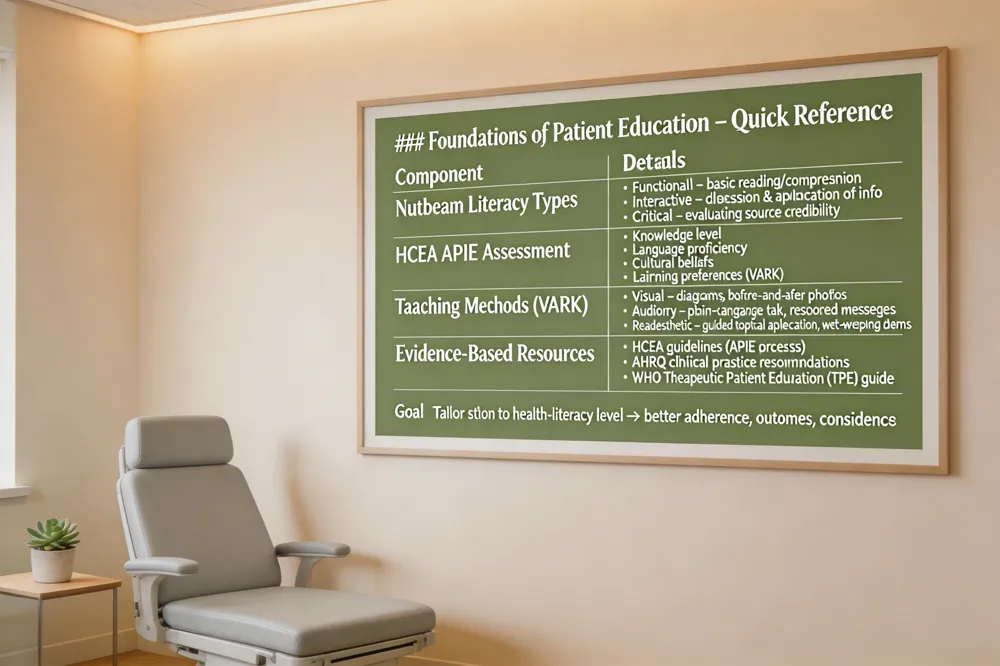 Effective dermatology education begins with health‑literacy awareness. Nutbeam’s model distinguishes functional literacy (basic reading and comprehension), interactive literacy (the ability to discuss and apply information), and critical literacy (evaluating credibility of sources). To address each dimension, clinicians must first assess a patient’s current knowledge, language proficiency, cultural beliefs, and learning preferences, as outlined in the HCEA APIE (Assessment‑Planning‑Implementation‑Evaluation) framework.
Using the assessment data, educators select personalized teaching methods that match the patient’s VARK style: visual tools (diagrams of skin layers, before‑and‑after photos), auditory cues (plain‑language explanations, recorded messages), and kinesthetic demonstrations (guided application of topical agents, wet‑wrapping techniques).
All interventions should be grounded in evidence‑based guidelines. The HCEA guidelines provide a structured APIE process, AHRQ offers national clinical practice recommendations, and the WHO’s Therapeutic Patient Education (TPE) guide emphasizes patient‑centered, culturally sensitive curricula. Integrating these resources ensures that education is accurate, culturally competent, and tailored to each patient’s health‑literacy level, ultimately improving adherence, outcomes, and confidence in navigating dermatologic care.
Navigating Health Insurance and Policy
Insurance & Policy – Patient Concerns Snapshot
| Plan Type | Key Covered Dermatology Services | Typical Patient Concerns |
|---|---|---|
| ACA (Most U.S. plans) | Preventive skin‑cancer screenings, medically necessary dermatology services | Deductibles, out‑of‑pocket max, prior‑auth delays |
| Medicaid / Medicare | Preventive benefits, biopsies, excisions, chronic disease treatment (eczema, psoriasis) | Understanding eligibility, coverage limits |
| Private Insurers | Same as ACA but may require prior‑auth for biologics, lasers, isotretinoin | Prior‑authorization forms, appeal process |
| Patient Poll Data | — | 25 % need guidance on preventive‑care coverage<br>25 % want deductible/out‑of‑pocket clarification<br>28 % ask when coverage will be denied |
| Overall Confidence | — | 72 % of insured adults lack confidence navigating plans (75 % Medicaid) |
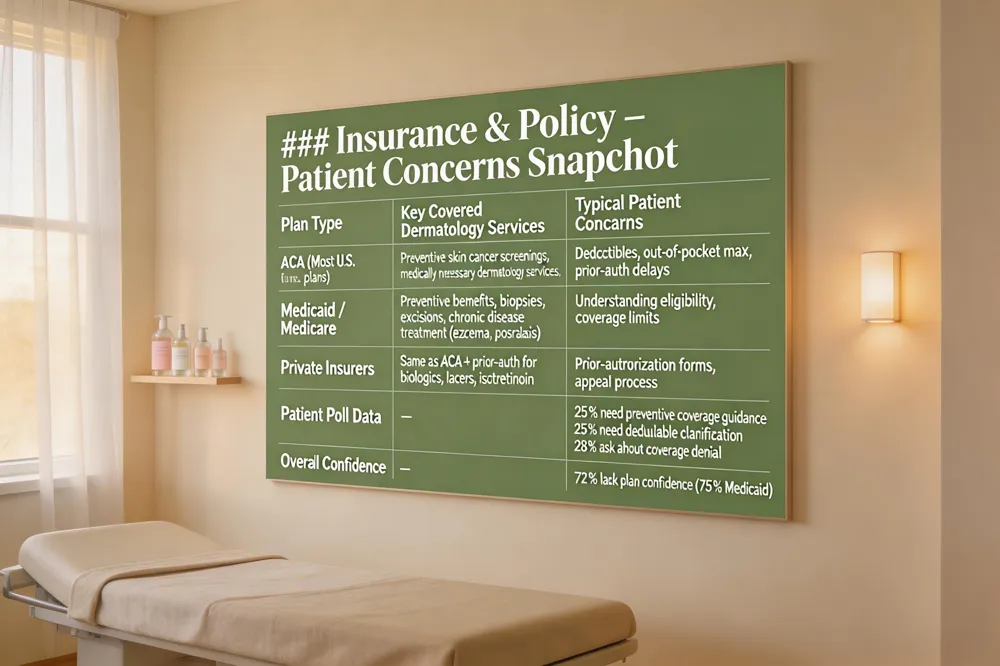 The Affordable Care Act (ACA) requires most U.S. health plans to cover medically necessary dermatology services, including preventive skin‑cancer screenings, without cost‑sharing. For patients with Medicaid or Medicare, the same preventive benefits apply, and both programs cover essential dermatologic procedures such as biopsies, excisions, and treatment of chronic conditions (e.g., eczema, psoriasis). Private insurers often follow ACA mandates but may require prior‑authorization for higher‑cost therapies like biologics, laser treatments, or isotretinoin. Dermatology Associates, PC assists patients in completing prior‑authorization forms and appeals to minimize delays.
Common concerns revolve around deductibles, out‑of‑pocket maximums, and coverage denials. 25 % of insured adults seek guidance on preventive‑care coverage, another 25 % want clarification on deductibles and out‑of‑pocket limits, and 28 % ask when plans will deny coverage. The PAN Foundation poll underscores these worries: 72% of insured adults lack confidence navigating health plans, with Medicaid patients reporting the highest insecurity (75 %). Clear, plain‑language explanations of benefits, cost‑sharing structures, and step‑by‑step navigation tools can dramatically improve patient confidence and adherence to dermatologic treatment plans.
Key Dermatology Patient‑Education Tools and Resources
Patient‑Education Tools – At a Glance
| Tool | Source | Format | Features |
|---|---|---|---|
| Online Portals | AAD, DermNet, MedlinePlus, UpToDate | Web pages, searchable databases | Peer‑reviewed, plain‑language summaries, high‑quality images |
| Handouts | AAD pamphlets, AACD handouts, practice‑specific sheets | Printable PDF, electronic | 6‑8th grade reading level, multilingual, concise disease & after‑care info |
| PDFs | In‑house or adapted from MedlinePlus | Downloadable PDF | Clear headings, bullet points, visual aids; emailed or portal‑linked |
| Skin‑Disease List with Pictures | University of Iowa Image Index or custom | Visual reference for self‑identification, condition monitoring | |
| EHR‑Embedded Library | Integrated into patient portal | Secure, HIPAA‑compliant | Consistent delivery, shared decision‑making support |
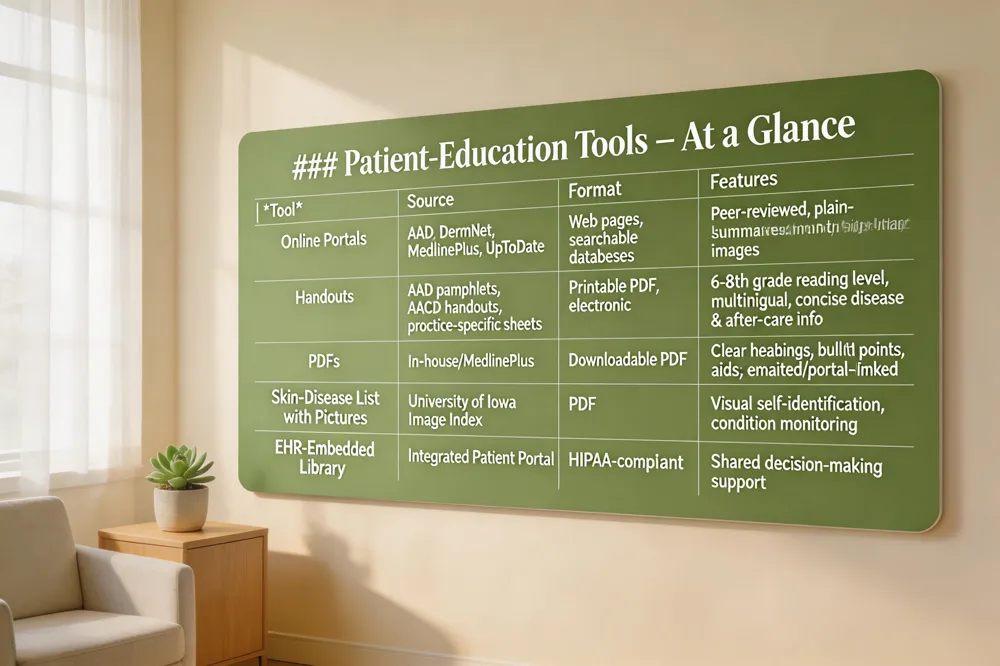 Trusted online portals such as the American Academy of Dermatology (AAD), DermNet, MedlinePlus, and UpToDate offer peer‑reviewed, searchable condition databases, high‑quality images, and plain‑language summaries that help patients understand acne, eczema, psoriasis, skin‑cancer prevention, and cosmetic procedures before their visit.
Patient‑education handouts are concise, 6‑to‑8th‑grade‑level sheets that explain disease basics, treatment steps, and after‑care instructions. At Dermatology Associates, PC we provide AAD pamphlets, AACD handouts and practice‑specific sheets in printable and electronic formats, available in multiple languages to meet Indiana’s diverse community needs.
Patient‑education PDFs combine clear headings, bullet points, and visual aids (diagrams, before‑and‑after photos). They can be generated in‑house or adapted from reputable sources like MedlinePlus, then emailed or uploaded to the secure patient portal for easy reference after the appointment.
A skin‑disease list with pictures PDF can be sourced from academic image indexes (e.g., University of Iowa Clinical Skin Disease Image Index) or custom‑created to highlight the conditions treated at our practice, giving patients a quick visual reference for self‑identification and monitoring.
All materials are integrated into our EHR‑embedded education library and patient portal, ensuring consistent, HIPAA‑compliant delivery, supporting shared decision‑making, and strengthening patient confidence in navigating dermatologic care.
Practical Guidance for Common Skin Conditions
Quick Guides for Common Conditions
| Condition | Key Education Point | Mnemonic / Rule |
|---|---|---|
| Lupus‑related Interface Dermatitis (5 L’s) | Recognize dense lymphocytic infiltrate at dermo‑epidermal junction | 5 L’s: Tumor‑type, Jessner’s, Plaque‑type PMLE, Lymphocytoma cutis, Classic lupus |
| Eczema | Moisturize within 3 min of bathing while skin is damp | 3‑Minute Rule |
| Medication Use | Explain purpose, dosing, side‑effects in plain language | Teach‑Back for comprehension |
| Acne | Expect 4‑8 weeks for response; consistent use needed | Set realistic goals, discuss lifestyle |
| General Strategy | Use teach‑back, shared decision‑making, multimedia handouts matching VARK | Tailor to visual/auditory/kinesthetic learners |
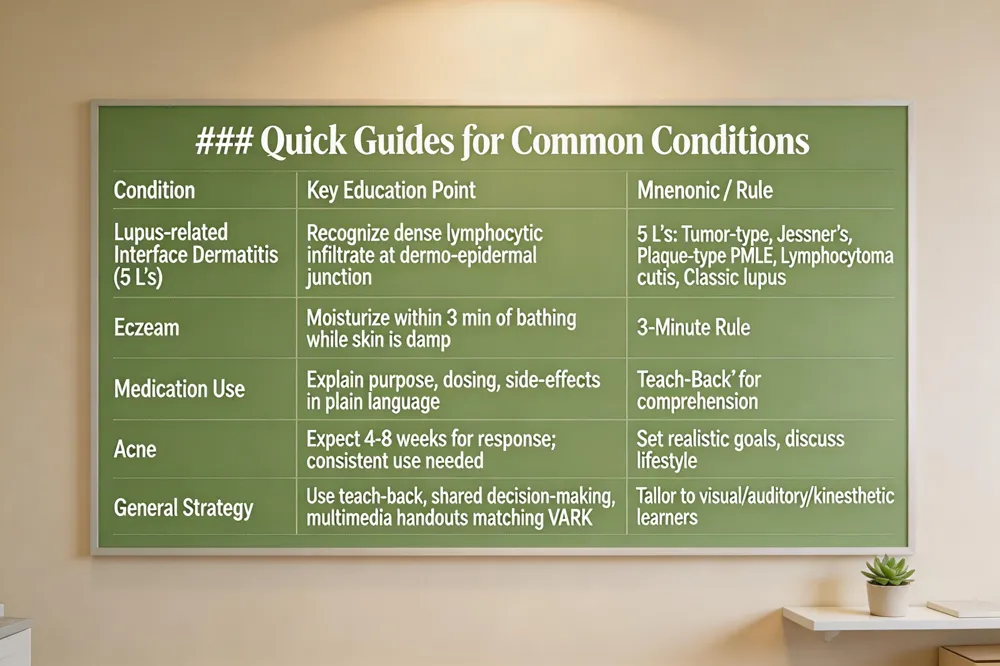 What are the 5 L’s in dermatology?
The “5 L’s” are lupus‑related interface dermatitis entities: tumor‑type lupus erythematosus, Jessner’s lymphocytic infiltrate, plaque‑type polymorphous light eruption (PMLE), lymphocytoma cutis, and classic (true) lupus erythematosus. Recognizing their shared dense lymphocytic infiltrate at the dermo‑epidermal junction aids accurate diagnosis and targeted patient education.
What is the 3‑minute rule for eczema?
Apply a fragrance‑free moisturizer or prescribed ointment within three minutes of bathing while the skin remains slightly damp. This rapid “lock‑in” of moisture restores the barrier, reduces itch‑scratch cycles, and improves flare‑up control.
Importance of patient education on medication
Clear, plain‑language counseling about drug purpose, dosing, and side‑effects boosts adherence, prevents errors, and empowers patients to self‑manage skin conditions safely. This is an example of effective patient education.
Acne patient education
Explain the pathophysiology, expected 4‑8‑week response time, and the need for consistent use of topical/oral agents. Emphasize lifestyle factors, set realistic goals, and schedule follow‑up to adjust therapy. Proper patient education improves outcomes.
Dermatology disease list (A‑Z)
Provide an indexed library of common and rare conditions—acne, atopic dermatitis, psoriasis, basal cell carcinoma, melanoma, etc.—in simple language and visual formats, accessible via the patient portal. This library supports patient education.
Patient‑education strategies
Use teach‑back, shared decision‑making, and multimedia handouts (print, video, EHR‑linked PDFs) to match learning styles (visual, auditory, kinesthetic) and cultural needs.
Dermatology education requirements for providers
Clinicians must follow the APIE process (Assessment, Planning, Implementation, Evaluation), disclose conflicts of interest, and stay current with AAD, HCEA, and HIPAA guidelines to deliver trustworthy, patient‑centered education.
Implementing Effective Education Strategies in Practice
Implementation Strategies – Summary Table
| Strategy | Description | Example in Dermatology |
|---|---|---|
| Teach‑Back (Ask‑Tell‑Ask) | Patient repeats instructions in own words to confirm understanding | Demonstrate steroid application, patient describes steps backn |
| Multimedia & Digital Platforms | Mobile apps, AI chatbots, automated reminders (HIPAA‑secure) | Send daily moisturizer reminder via patient portal |
| Language & Literacy Adaptations | Plain‑language translations, 8th‑grade reading level, visual aids | Provide bilingual handouts, use diagrams for low‑literacy patients |
| Privacy & Security | Secure patient portals, encrypted communications | Upload PDFs to HIPAA‑compliant portal only accessible to patient and care team |
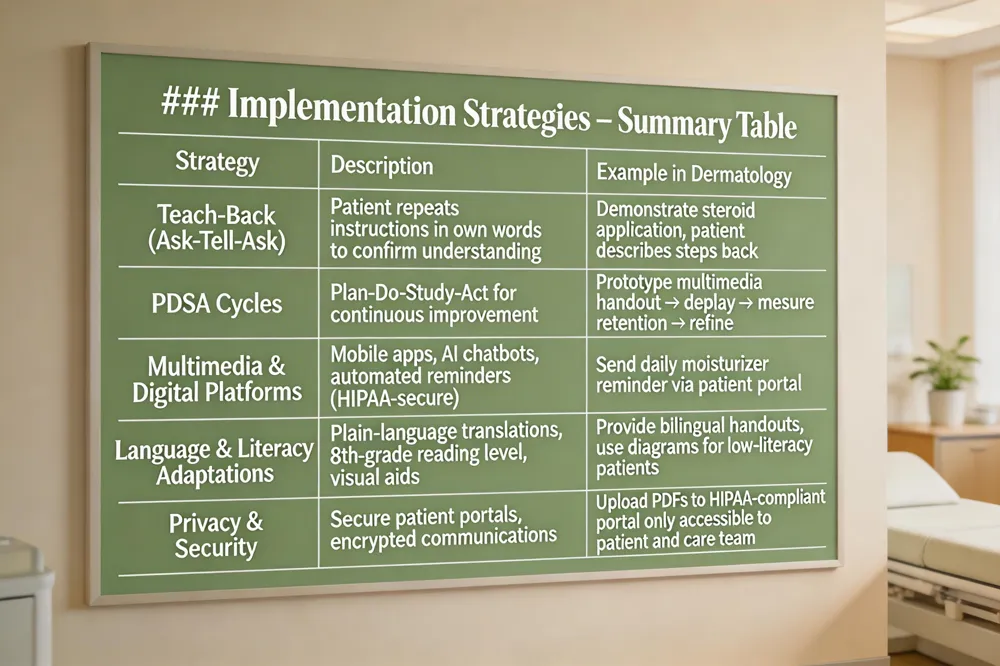 Effective patient education in dermatology blends concise communication, evidence‑based tools, and continuous quality improvement. The teach‑back method—ask, tell, ask for patient users describes the steps for applying a topical steroid, then repeats it in their own words to confirm comprehension. To refine education workflows, clinics can run Plan‑Do‑Study‑Act (PDSA) cycles: prototype a multimedia handout, deploy it, measure retention, and adjust content accordingly. Multimedia and digital platforms—mobile apps, AI chatbots, and automated reminders—extend reach, but must respect health‑literacy levels, language needs and HIPAA privacy safeguards. Language barriers are mitigated with plain‑language translations and visual aids; low literacy is addressed by using 8th‑grade reading levels and the VARK model; privacy concerns are managed through secure patient portals and encrypted communications.
Patient‑education nursing examples: nurses demonstrate proper topical application, pre‑procedure counseling for laser or peels, sun‑protection teaching, and follow‑up calls to reinforce plans.
Policy example: an Infection‑Control and Sterile‑Technique Policy mandates hand hygiene, instrument disinfection, PPE use, and documentation logs for every dermatologic encounter.
5 P’s of patient care: pain, restroom, possessions, position, and safety are assessed hourly.
7 habits off‑limits for dermatologists: skip big skincare routines, enforce sunscreen use, avoid triple‑antibiotic creams, prohibit nighttime pimple popping, limit new product introductions, and discourage gel manicures.
Building Confidence Through Knowledge
Trusted patient education is directly linked to better health outcomes, higher medication adherence, and reduced adverse events. In dermatology, clear explanations of skin‑cancer screening, biologic therapies, and sunscreen use improve self‑care and early detection, while multimedia handouts and brief repeat teach‑back sessions boost recall. Patients are encouraged to explore the American Academy of Dermatology’s online pamphlets, Dermatology Associates, PC’s printed and digital handouts, and the practice’s secure patient portal for personalized videos and reminders. Asking questions during visits—about treatment options, insurance coverage, or follow‑up plans—ensures understanding and aligns care with individual values. Dermatology Associates, PC serves as a trusted partner, providing plain‑language resources, family‑oriented counseling, and ongoing support through tele‑dermatology and AI‑driven chatbots, empowering patients to navigate their skin health confidently and collaboratively.