Why Look Beyond Mohs?
Early detection of skin cancer dramatically expands therapeutic options. When a lesion is identified while still superficial, clinicians can often choose less‑invasive modalities—such as topical imiquimod or 5‑fluorouracil, cryosurgery, or image‑guided superficial radiation therapy (IGSRT)—that avoid the incision, scar, and wound‑care required after Mohs surgery. Many patients prioritize cosmetic outcomes, especially for facial or cosmetically sensitive sites; non‑surgical treatments typically leave no visible scar and allow immediate return to daily activities, a factor highlighted by GentleCure’s IGSRT data showing >99 % cure rates with negligible scarring. At Dermatology Associates, PC, a multidisciplinary team—including dermatologists, Mohs surgeons, radiation oncologists, and medical oncologists—collaborates to match tumor characteristics, patient health, and aesthetic goals, ensuring a personalized plan that balances oncologic control with quality‑of‑life preferences.
Non‑Surgical Alternatives for Basal Cell Carcinoma
| Modality | Mechanism | Cure Rate | Cosmetic Outcome | Typical Use Cases |
|---|---|---|---|---|
| Curettage & Electrodesiccation (ED&C) | Scrape lesion with curette, destroy residual cells with electrosurgery | ~95 % for small, low‑risk tumors | Good, may leave mild scarring | Small, superficial BCCs on trunk or extremities |
| Cryotherapy | Liquid nitrogen (or argon) freeze | Lesion | 85‑90 % clearance | Excellent, preserves surrounding skin |
| Photodynamic Therapy (PDT) | Topical photosensitizer + specific light wavelength | 80‑90 % cure, excellent cosmetic results | Near‑normal skin texture | Facial or cosmetically sensitive areas |
| Topical Immunomodulators/Chemotherapy (imiquimod, 5‑FU, tirbanibulin) | Daily topical application causing immune response or cytotoxicity | 80‑90 % cure | No incisions, minimal scarring | Superficial lesions, patients preferring at‑home treatment |
| GentleCure™ / IG‑SRT | Ultrasound‑guided low‑dose X‑ray delivery | >99 % local control for selected lesions | No scar, minimal downtime | Patients poor surgical candidates, or seeking non‑invasive option |
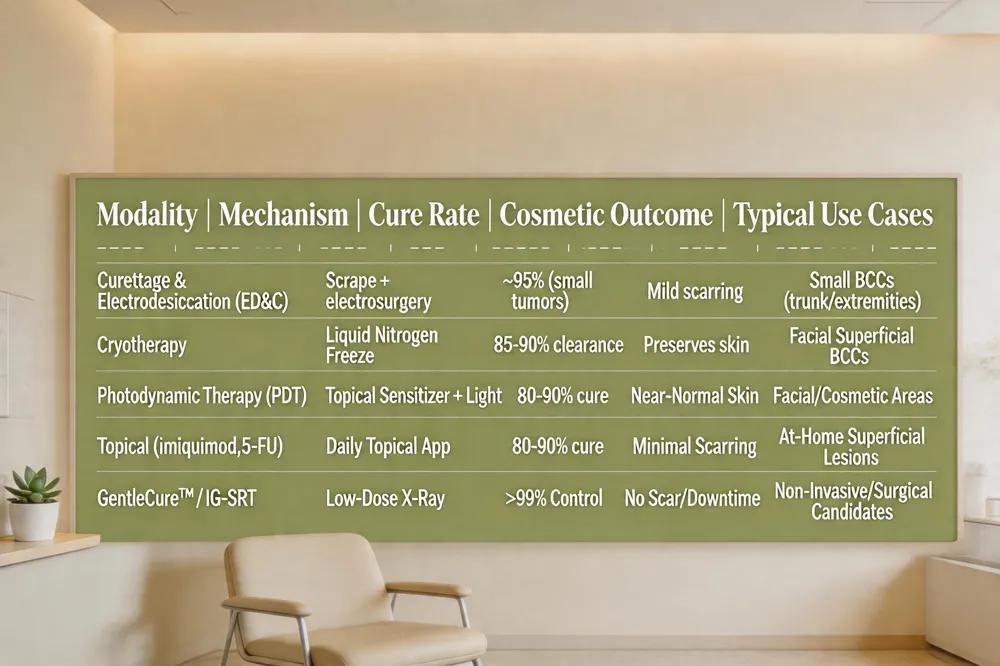 Basal cell carcinoma (BCC) can be managed without Mohs surgery using several evidence‑based modalities. Curettage and electrodesiccation (ED&C) involves scraping the lesion with a curette and destroying residual cells with electrosurgery; it is quick, inexpensive, and yields cure rates of 95 % for small, low‑risk tumors. Cryotherapy applies liquid nitrogen (or argon) to freeze superficial BCCs, offering 85‑90 % clearance while preserving surrounding skin. Photodynamic therapy (PDT) uses a topical photosensitizer activated by a specific light wavelength to eradicate cancer cells with excellent cosmetic results, especially on the face. Topical immunomodulators and chemotherapy such as imiquimod, 5‑fluorouracil, or tirbanibulin are applied daily to superficial lesions, achieving 80‑90 % cure rates and avoiding incisions. Image‑guided superficial radiation therapy (GentleCure™/IG‑SRT) delivers low‑dose X‑rays precisely to the tumor, guided by high‑frequency ultrasound; clinical data show >99 % local‑control rates for appropriately selected BCCs, with no scarring and minimal downtime. These alternatives provide effective, cosmetically favorable options for patients who are poor surgical candidates or who prefer non‑invasive treatment.
Non‑Surgical Alternatives for Squamous Cell Carcinoma
| Modality | Mechanism | Cure Rate | Cosmetic Outcome | Typical Use Cases |
|---|---|---|---|---|
| Standard Surgical Excision | Excision with predetermined margins | >95 % cure | Linear scar, variable cosmetic result | Low‑to‑moderate risk SCC, various locations |
| ED&C (Electrodessication & Curettage) | Scrape lesion, destroy residual cells with electric current | Good for small, superficial SCCs | Small scar or none | Small, well‑defined SCC lesions |
| Cryotherapy | Liquid nitrogen freeze | 85‑90 % clearance | Good, minimal scarring | Superficial, well‑defined SCCs |
| Topical 5‑FU / Imiquimod | Daily topical application causing inflammation and tumor clearance | 80‑90 % cure | No incisions, excellent cosmetic result | SCC in situ or superficial SCC |
| Photodynamic Therapy (PDT) | Photosensitizer + light activation | 80‑90 % cure | Excellent cosmetic outcome | Facial or cosmetically sensitive SCC |
| CO₂ Laser Ablation | Precise laser vaporization of lesion | High cure for selected lesions | Excellent cosmetic result | Superficial SCC, patients preferring non‑surgical |
| GentleCure™ / IG‑SRT | Ultrasound‑guided low‑dose X‑ray delivery | >99 % local control for selected lesions | No scar, minimal downtime | Patients poor surgical candidates, or seeking non‑invasive option |
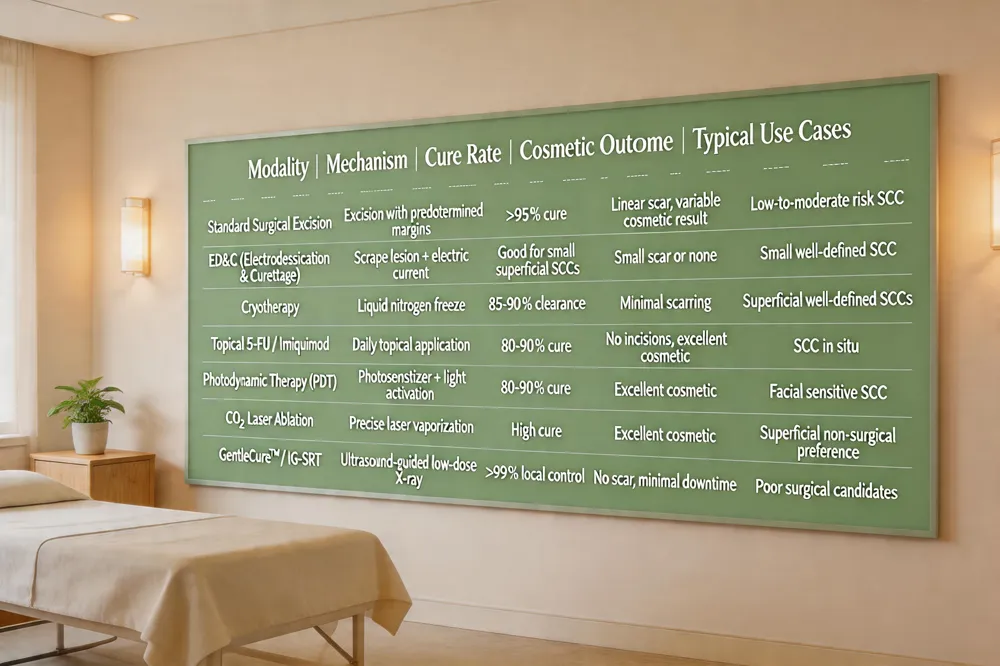 Squamous cell carcinoma (SCC) can be managed without Mohs surgery using several evidence‑based modalities. Standard surgical excision with predetermined margins removes the tumor in one piece and is appropriate for many low‑to‑moderate risk lesions. Electrodessication and curettage (ED&C) scrapes the lesion and uses electric current to destroy residual cells, offering rapid office treatment for small, superficial SCCs. Cryotherapy freezes cancerous tissue with liquid nitrogen, providing a quick, scar‑minimizing option for well‑defined lesions. Topical 5‑fluorouracil and the immune‑modulating cream imiquimod are applied to superficial SCC or in‑situ disease, causing controlled inflammation that clears the tumor over weeks. Photodynamic therapy (PDT) and CO₂ laser ablation deliver precise tissue destruction while preserving cosmetic appearance. Image‑guided superficial radiation therapy (GentleCure™) uses ultrasound‑guided low‑dose X‑rays, achieving cure rates >99 % without incisions, ideal for patients who are poor surgical candidates.
What are the alternatives to Mohs surgery for squamous cell carcinoma? Non‑Mohs options include the modalities described above, each selected based on tumor size, depth, location, and patient health.
What is the best treatment for squamous cell carcinoma in situ? Mohs micrographic surgery remains the gold‑standard for highest clearance, but when surgery is contraindicated, a combined CO₂ laser‑dermabrasion and topical 5‑FU regimen, or topical 5‑FU/imiquimod alone, can achieve acceptable clearance with excellent cosmetic results.
Understanding Referral Timelines and Success Rates
| Step | Timeline (days) | Typical Outcome / Notes |
|---|---|---|
| Primary care suspicion & referral request | ≤1 (within 24 h) | Referral initiated for high‑risk skin cancer |
| Specialist appointment (first consult) | ≤14 (two‑week rule) | Patient seen by dermatologist or oncologist |
| Biopsy & pathology report | ≤3–5 after consult | Diagnosis confirmed, staging ordered |
| Treatment planning (surgical) | 7–14 after diagnosis | Excision or Mohs scheduled 1–2 weeks |
| Treatment planning (GentleCure™/IG‑SRT) | 14–28 after diagnosis | Ultrasound mapping & fraction schedule 2–4 weeks |
| Treatment series (IG‑SRT) | 5–10 consecutive days | Low‑dose X‑ray fractions delivered |
| Recovery & wound care | ≤7 days (surgical) or 0 days (IG‑SRT) | Return to normal activities |
| Follow‑up for clearance | 30–60 days post‑treatment | Clinical exam to confirm cure |
| Overall cure rates | — | Mohs ≈99 %, standard excision >95 %, IG‑SRT >99 % (selected lesions) |
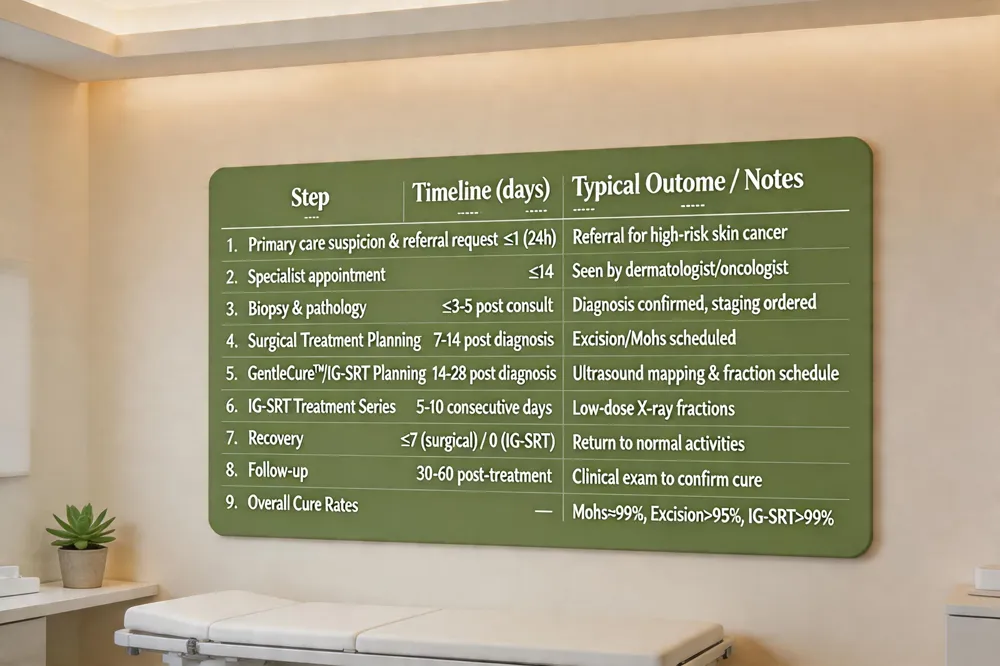 The “two‑week rule” for skin‑cancer referrals is a fast‑track pathway that obliges primary‑care providers to arrange a specialist appointment within 14 days of suspecting a high‑risk lesion (e.g., aggressive basal‑cell carcinoma, squamous‑cell carcinoma, or melanoma). The referral must be made within 24 hours, and treatment should begin within 62 days of the initial consult, aiming to minimize diagnostic delays and disease progression. Once a biopsy confirms cancer, staging tests (CT, MRI, sentinel node biopsy) are ordered within a few days. For most basal‑cell and squamous‑cell cancers, surgical excision or Mohs micrographic surgery is scheduled within 1–2 weeks; non‑surgical options such as Image‑Guided Superficial Radiation Therapy (IG‑SRT, marketed as GentleCure™) may require 2–4 weeks for planning and a 5–10‑day treatment series. The procedure itself lasts under an hour, with a brief recovery of a few days to a week. Overall cure rates are high: Mohs surgery achieves up to 99 % cure for primary tumors, standard excision exceeds 95 %, and I‑SRT reports cure rates of 99 % or higher for appropriately selected lesions. The full diagnosis‑to‑follow‑up journey typically spans 4–8 weeks.
GentleCure™: How It Works and What to Expect
| Aspect | Details |
|---|---|
| Technique | Real‑time high‑frequency ultrasound maps tumor depth & margins; low‑dose X‑ray beam precisely targets cancer cells |
| Session Length | 10–15 minutes per fraction (no anesthesia) |
| Number of Fractions | Typically 5–10 daily sessions |
| Side Effects (common) | Mild redness, swelling, sun‑burn‑like sensation, temporary pigment change, thinning of skin, localized hair loss |
| Side Effects (rare) | Ulceration, secondary skin cancer (decades later) |
| Contraindications | Radiation hypersensitivity, active infection at site, lesions deeper than superficial dermis, pregnancy (unless benefit outweighs risk), severe skin‑integrity disorders |
| Medicare Coverage | Part B covers outpatient IGSRT; Part A may cover inpatient delivery when ordered by physician; usually medically necessary for BCC/SCC |
| Typical Cost (Indiana) | $150–$200 per fraction; most insurers cover majority; out‑of‑pocket varies |
| Recovery | No cuts, sutures, or anesthesia; mild redness resolves within weeks |
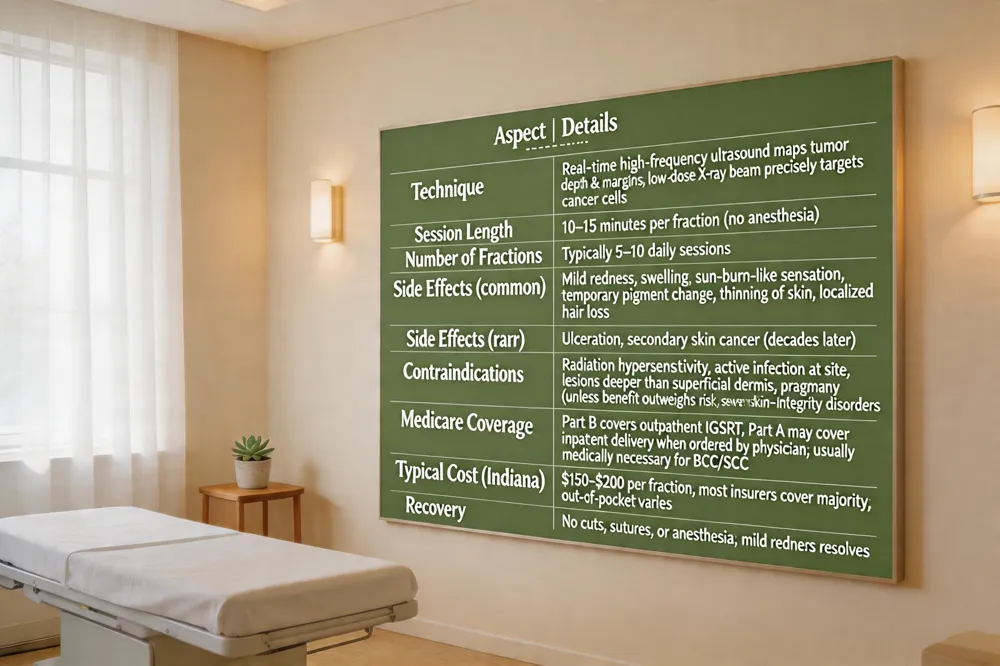 GentleCure™ (IT‑guided superficial radiation therapy, IGSRT) uses real‑time ultrasound to map a basal‑cell or squamous‑cell lesion and then delivers low‑dose X‑ray energy precisely to the cancer cells. Unlike Mohs surgery, which removes tumor layers under local anesthesia and leaves a surgical wound, GentleCure™ requires no cuts, sutures, or anesthesia and therefore produces no scar tissue.
Side‑effects are usually mild and short‑lived: temporary redness, swelling, a sun‑burn‑like feeling, mild irritation, occasional pigment change, thinning of skin, or localized hair loss. Rarely, ulceration or a secondary skin cancer may occur decades later.
Contraindications include known radiation hypersensitivity, active infection at the treatment site, lesions deeper than the superficial dermis, pregnancy (unless benefits outweigh risks), and severe skin‑integrity disorders.
Medicare coverage: IGSRT is generally covered when medically necessary for BCC or SCC; Part B pays for outpatient services and Part A can cover inpatient delivery, subject to usual physician‑order and deductible requirements.
Cost in Indiana: Out‑of‑pocket fees vary—simple excision ≈ $150 per lesion, Mohs surgery $2,500‑$5,000, Cryosurgery $75‑$150. GentleCure™ is billed per fraction, typically $150‑$200 per session, with most insurers covering the majority of costs.
Treatment session: The area is cleansed, ultrasound maps the tumor, a custom lead shield is placed, and a 10‑15‑minute low‑dose X‑ray beam is delivered while you remain fully awake. No anesthesia or recovery time is needed; mild redness may appear and resolves within weeks.
Follow‑Up Care, Common U.S. Treatments, and Finding Your Dermatologist
| Follow‑up Interval | Purpose | Typical Provider |
|---|---|---|
| 3–6 months (first 2 years) | Check treated site, regional nodes, early recurrence | Dermatologist |
| 6–12 months (after 2 years) | Ongoing surveillance for new lesions | Dermatologist or primary‑care |
| Monthly | Self‑examination for new or changing lesions | Patient |
| Annually | Full skin exam, sun‑safety counseling | Dermatologist |
| Common U.S. Treatments | Surgical excision, Mohs micrographic surgery, Curettage & ED&C, Cryotherapy, Topical 5‑FU/Imiquimod, Photodynamic Therapy (PDT), Image‑guided superficial radiation (GentleCure™) | — |
| Finding a Dermatologist (Indianapolis) | Dermatology Associates, PC (Medicaid‑accepting) – other providers via Indiana Medicaid Provider Directory or Zocdoc | — |
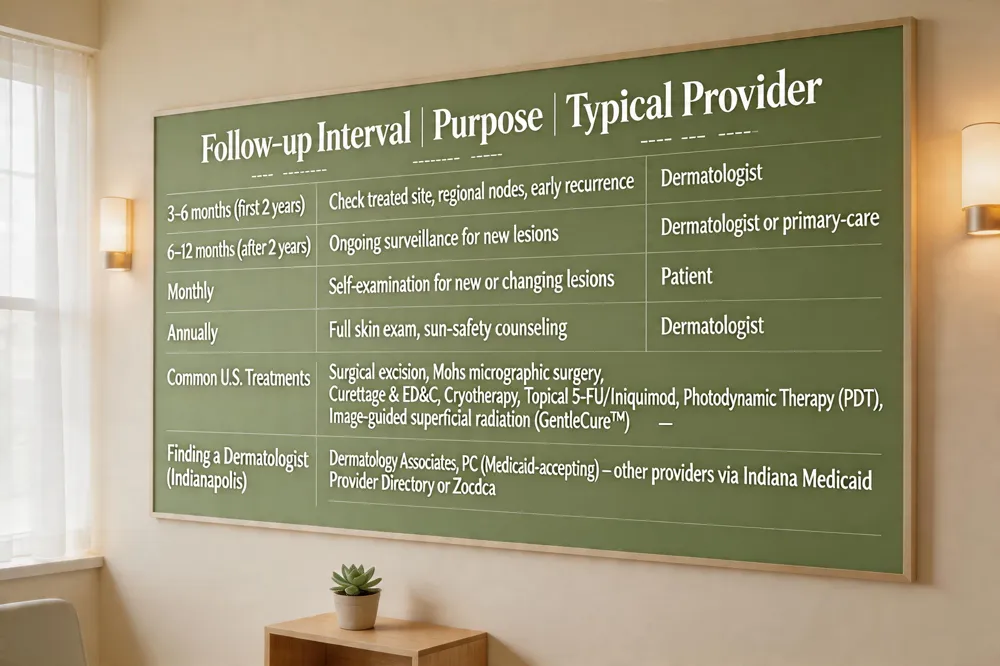 After skin‑cancer treatment, dermatologists typically schedule exams every 3–6 months for the first two years for melanoma and every 6–12 months for basal‑cell or squamous‑cell carcinoma, checking the treated site, regional nodes, and imaging as needed. Patients should perform monthly self‑examinations and practice daily sun‑safety (broad‑spectrum SPF 30+, protective clothing, avoid peak UV). The most common U.S. therapies are surgical excision and Mohs micrographic surgery, followed by curettage with electrodessication, cryotherapy, topical 5‑fluorouracil or imiquimod, photodynamic therapy (PDT), and image‑guided superficial radiation (e.g., GentleCure™. For Medicaid‑accepting dermatologists in Indianapolis, Dermatology Associates, PC offers both medical and cosmetic care; additional providers can be located via the Indiana Medicaid Provider Directory or Zocdoc. PDT works by applying a photosensitizing cream (5‑ALA or MAL) that accumulates in abnormal cells, then illuminating the area with a specific light wavelength to generate reactive oxygen species that destroy cancer cells while sparing healthy skin.
Your Path to Personalized Skin Cancer Care
At Dermatology Associates, PC, every patient receives clear, personalized education about their diagnosis and treatment options, empowering shared decision‑making. A multidisciplinary team—including board‑certified dermatologists, Mohs surgeons, radiation oncologists, and medical oncologists—collaborates to design the most effective, evidence‑based plan for each case. Early detection is emphasized through regular skin exams and self‑screening guidance, while prompt, tailored therapies—ranging from Mohs surgery to image‑guided superficial radiation—ensure optimal oncologic control and long‑term skin health.