Understanding Skin Cancer and Treatment Options
Non‑melanoma skin cancers—primarily basal cell carcinoma and squamous cell carcinoma—are the most common cancers in the United States, affecting roughly one in five Americans. Early detection and precise histologic diagnosis are critical because they enable curative treatment before tumors become large or invasive. Treatment options range from non‑surgical modalities such as topical chemotherapy, cryotherapy, and photodynamic therapy to surgical approaches, with Mohs micrographic surgery offering the highest cure rates (up to 99% for primary lesions) and the best cosmetic preservation for high‑risk or cosmetically sensitive sites. Dermatologists trained in Mohs and other skin‑cancer techniques provide personalized care, coordinating diagnosis, margin‑controlled excision, and immediate reconstruction to optimize oncologic and aesthetic outcomes.
What Patients Should Know Before Undergoing Mohs Surgery
 Before your Mohs micrographic surgery, dress in loose, comfortable clothing—think a soft sweatshirt and easy‑to‑change pants—so you can be re‑dressed quickly after the procedure. Schedule a full‑day appointment; most cases last 4‑6 hours, but larger or high‑risk tumors may require a longer stay, so arrange transportation and keep the day free of other commitments. Bring a complete list of current medications, supplements, and any allergy information; your surgeon may ask you to pause blood‑thinners or certain supplements after a brief consultation.
What I wish I knew before Mohs surgery? Wear comfortable attire, plan for a full‑day visit, and have a ride home. Bring medication details and be prepared for a short recovery with mild swelling, bruising, and a tight‑feeling wound that typically improves within a week.
Mohs surgery recovery Recovery is rapid. Expect mild swelling, bruising, and tightness for a few days. The wound may close by secondary intention, sutures, grafts, or flaps, depending on size and location. Pain is usually controlled with over‑the‑counter analgesics. Full cosmetic results emerge after 4‑6 weeks as the skin remodels. Keep the site clean, protect it from sun exposure, and follow dressing instructions for optimal healing.
Emerging Non‑Surgical Alternatives to Mohs
 Superficial Radiation Therapy (SRT) is a non‑surgical option that uses low‑energy X‑rays to treat the upper dermal layers. Treatments are delivered in a series of 5–10 short sessions over 2–3 weeks, allowing the radiation dose to be confined to the lesion while sparing deeper structures. SRT is most appropriate for superficial basal cell carcinomas and selected squamous cell carcinomas located in cosmetically sensitive sites—such as the face, ears, or hands—where surgical preservation of tissue is challenging. Compared with Mohs surgery, SRT often yields excellent cosmetic results because it avoids incisions and sutures, but it is limited to early‑stage, low‑risk tumors; invasive or high‑risk lesions remain better managed by Mohs surgery.
What is the new alternative to Mohs surgery?
Superficial Radiation Therapy (SRT) has emerged as a non‑surgical option for certain early‑stage skin cancers. Using low‑energy X‑rays, SRT treats the upper layers of the skin over multiple short sessions (typically 5–10 treatments over 2–3 weeks). It is most suitable for superficial basal cell carcinomas and some squamous cell carcinomas located in cosmetically sensitive areas where surgery would be challenging. While SRT offers excellent cosmetic outcomes, it is not appropriate for invasive or high‑risk tumors, which still benefit most from Mohs surgery.
Treatment Options for Squamous Cell Carcinoma
 Squamous cell skin cancer treatment options vary according to lesion size, depth, an, and risk factors.Risk‑stratification of SCC lesions helps distinguish low‑risk tumors (small, well‑defined, located on trunk or extremities) from high‑risk lesions (large, poorly defined, perineural invasion, facial or genital sites).
Mohs micrographic surgery as gold standard – For high‑risk or cosmetically sensitive SCCs, Mohs surgery provides 100 % margin assessment, achieving 5‑year cure rates of 95‑99 % while sparing healthy tissue and minimizing scarring. It is performed outpatient under local anesthesia, with immediate microscopic control and same‑day reconstruction.
Excisional surgery with clear margins – Low‑risk SCCs can be treated by conventional excision, removing the tumor with a 4‑6 mm peripheral margin. Cure rates are high (≈95 %) but margin assessment is less comprehensive than Mohs.
Topical, cryotherapy, and photodynamic modalities – Superficial SCC in‑situ or very small lesions may be managed with 5‑fluorouracil, imiquimod, cryotherapy, or PDT, offering non‑invasive options with modest cure rates and limited cosmetic impact.
Choosing the right approach for each patient – A multidisciplinary dermatology team evaluates tumor characteristics, patient comorbidities, and cosmetic priorities to select the most appropriate therapy, ensuring optimal oncologic control and functional/aesthetic outcomes.
Mohs Surgery on the Face: Technique and Outcomes
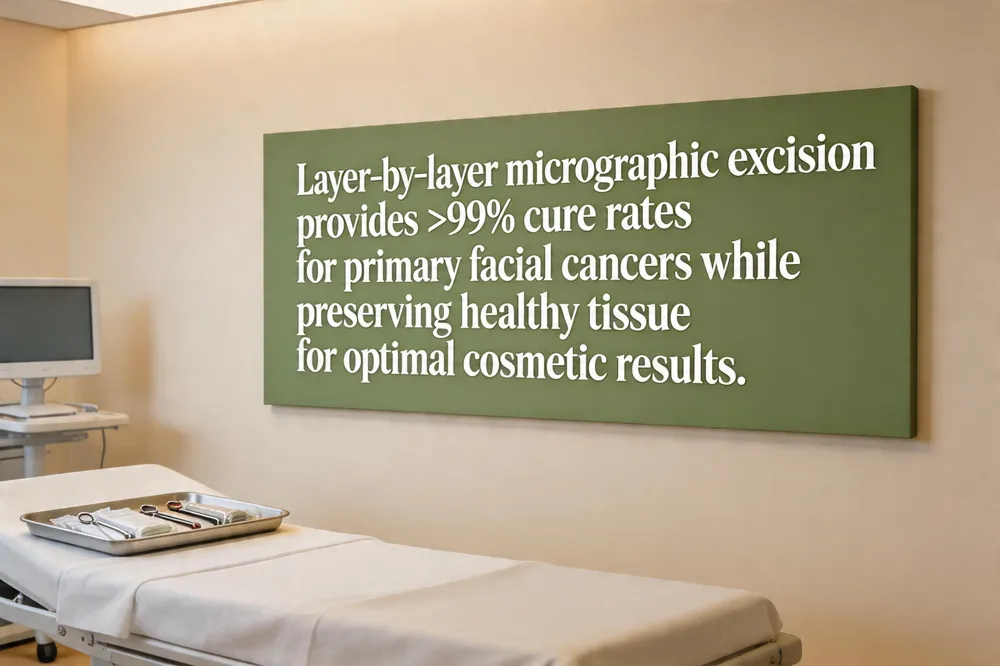 Facial Mohs surgery is performed in an outpatient setting under local anesthesia, allowing the patient to remain awake and return home the same day. The surgeon excises the visible tumor and then removes thin, peripheral layers of tissue, each of which is mapped, frozen, stained, and examined under a microscope in real time. This layer‑by‑layer approach continues until no cancer cells are detected, guaranteeing complete margin clearance while preserving as much healthy skin as possible. Because the technique spares normal tissue, cosmetic outcomes are excellent—scars are minimal and functional structures (e.g., eyelids, nose, lips) are retained. Cure rates for primary basal cell carcinoma and squamous cell carcinoma on the face exceed 99 %, with slightly lower but still high rates (≈ 95 %) for recurrent lesions. After tumor removal, the wound may be closed by primary suturing, local flap reconstruction, skin grafting, or secondary intention, depending on defect size and location. Post‑procedure care includes a protective dressing, over‑the‑counter analgesics for mild pain, and a follow‑up visit to monitor healing, manage scar care, and discuss any additional reconstructive needs.
Practical Considerations: Costs, Timeline, and When Mohs Isn’t Indicated
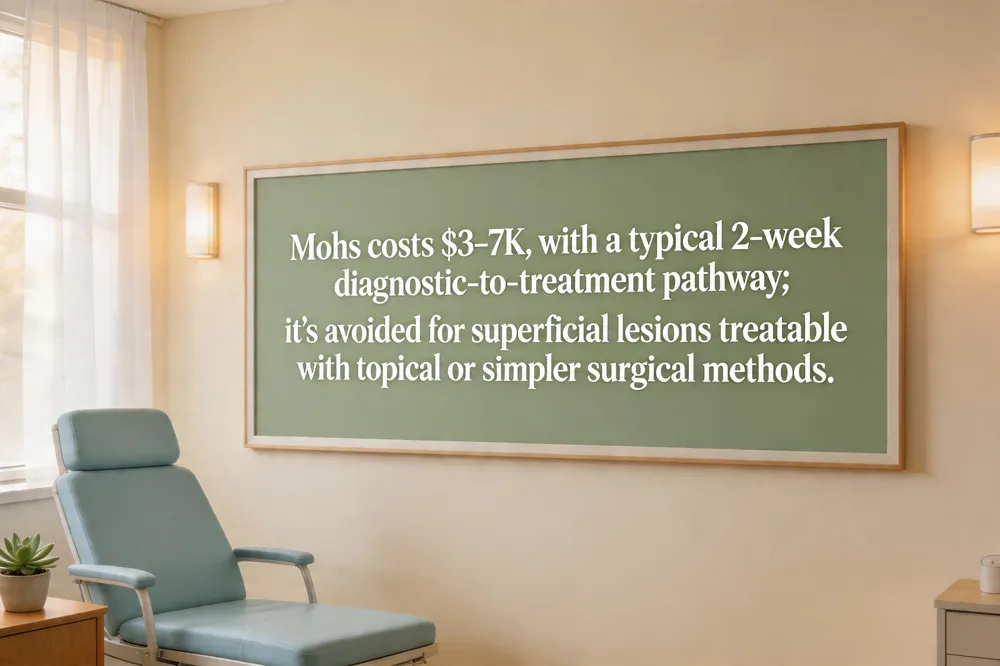 Mohs surgery delivers the highest cure rates for basal and squamous cell carcinomas, but its out‑of‑pocket cost is typically $3,000–$7,000 when including pathology and reconstruction. Superficial radiation therapy ranges $2,500–$5,000, conventional excision $1,500–$3,500, and topical agents $100–$300 per prescription. Most U.S. insurers, including Medicare, cover medically necessary skin‑cancer treatments, though patients should verify coverage for ancillary services such as wound care and reconstruction.
A typical diagnostic‑to‑treatment pathway proceeds as follows: (1) initial dermatology consult (same‑day or within a week); (2) biopsy and pathology (3–7 days); (3) treatment planning and scheduling (within 1–2 weeks); (4) definitive therapy (often 2–4 weeks after diagnosis); (5) postoperative follow‑up (1–2 weeks); and (6) long‑term surveillance every 6–12 months. This schedule aligns with the 2‑week rule, which mandates a specialist appointment within 14 days for lesions that raise suspicion for melanoma, BCC, or SCC based on high‑risk features.
Mohs is not preferred when lesions are superficial and amenable to topical therapy or cryotherapy, when they lie on extremities where simple excision yields clear margins, when patients cannot tolerate local anesthesia or prolonged procedures, or when the cancer is advanced (e.g., invasive melanoma) requiring wider margins or systemic therapy. In such cases, conventional excision, radiation, or systemic treatments are considered.
Your Path to Confident Skin Health with Dermatology Associates, PC
Dermatology Associates, PC provides board‑certified dermatologic surgeons who have completed fellowship training in Mohs micrographic surgery, ensuring expert margin control and tissue‑sparing technique. Patients receive personalized, compassionate care from diagnosis through treatment and follow‑up, with clear education on wound care and skin‑cancer surveillance. The practice emphasizes the highest cure rates—up to 99 % for primary basal and squamous cell carcinomas—and optimal cosmetic outcomes by preserving healthy skin and using reconstructive expertise. All procedures are performed in an outpatient setting under local anesthesia, and the staff assists with insurance verification and coverage to minimize financial barriers.