Understanding Post‑Weight‑Loss Body Contouring
Major weight loss—whether from bariatric surgery, lifestyle changes, or GLP‑1 medications—often leaves excess sagging skin and stubborn fat deposits because the skin’s collagen and elastin fibers lose elasticity after being stretched for years. Whether a patient is a good candidate for contouring depends on several factors: skin quality and elasticity, the amount of residual skin laxity, functional issues such as rashes or limited mobility, and the patient’s overall health. Surgeons require a stable weight (within ± 5–10 lb of the goal weight) for at least six months, a BMI typically below 35, and optimized nutrition without severe vitamin deficiencies to promote proper healing and lower infection risk. Smoking cessation, control of chronic diseases, and realistic expectations are also essential. When these criteria are met, body‑contouring surgery can safely remove excess skin and fat, improving shape, comfort, and self‑esteem.
Timing, Safety, and What to Expect
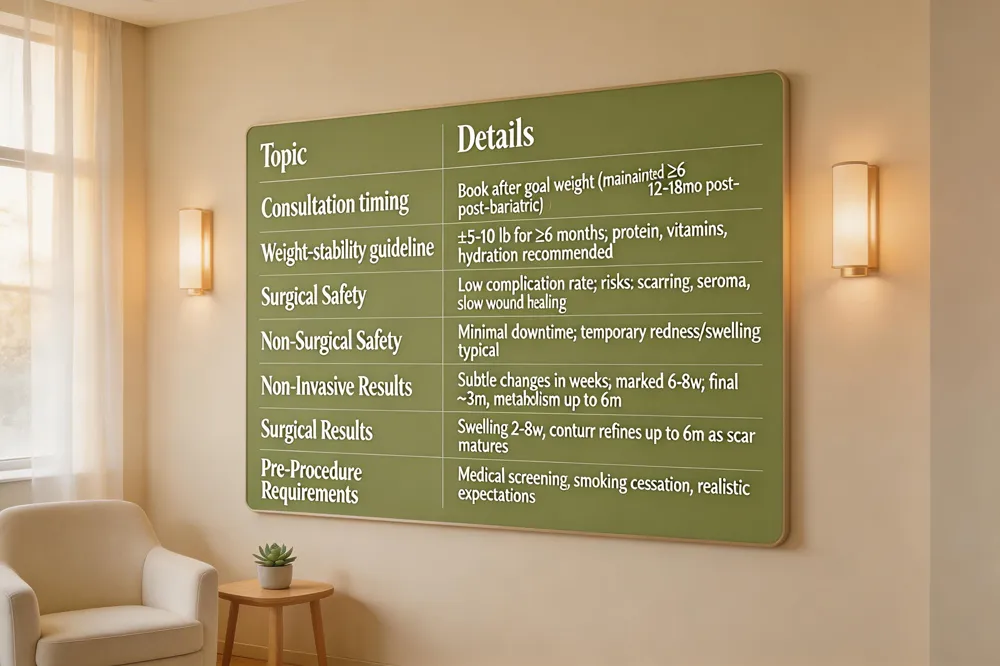
| Topic | Details |
|---|---|
| Consultation timing | Book after reaching goal weight and maintaining it for ≥6 months (often 12‑18 months post‑bariatric surgery). |
| Weight‑stability guideline | ±5‑10 lb of target weight for a minimum of 6 months; adequate protein, vitamins, and hydration recommended. |
| Safety profile – surgical | Low overall complication rate; risks limited to scarring, seroma, slower wound healing. |
| Safety profile – non‑surgical | Minimal downtime; temporary redness or swelling are typical. |
| Visible results – non‑invasive | Subtle changes within weeks; marked improvement 6‑8 weeks; final contour ~3 months; continued fat metabolism up to 6 months. |
| Visible results – surgical | Swelling subsides 2‑8 weeks; contour refines up to 6 months as scar matures. |
| Pre‑procedure requirements | Medical screening, smoking cessation, realistic expectations. |
 When to schedule a consultation
Patients should book a consultation after they have reached their goal weight and maintained it for at least six months (often 12‑18 months after bariatric surgery). A stable weight allows the skin to retract naturally and gives the surgeon a reliable baseline for planning.
When to schedule a consultation
Patients should book a consultation after they have reached their goal weight and maintained it for at least six months (often 12‑18 months after bariatric surgery). A stable weight allows the skin to retract naturally and gives the surgeon a reliable baseline for planning.
Weight‑stability guidelines Most experts recommend a weight range of ±5‑10 lb around the target weight for a minimum of six months before any contouring procedure. Nutritional optimization—adequate protein, vitamins, and hydration—further supports wound healing and reduces infection risk.
Safety profile of surgical and non‑surgical options Surgical contouring (e.g., abdominoplasty, brachioplasty, thigh lift) performed by board‑certified plastic surgeons carries a low overall complication rate, with risks limited to scarring, seroma, and slower wound healing. Non‑surgical modalities such as radiofrequency, ultrasound, and cryolipolysis have minimal downtime and primarily cause temporary redness or swelling. Both pathways require thorough medical screening, smoking cessation, and realistic expectations.
Typical timeline for visible results Non‑invasive treatments produce subtle changes within weeks; most patients see marked improvement between six and eight weeks, with final contouring evident around three months. Surgical results emerge as swelling subsides, typically within two to eight weeks, and continue to refine for up to six months as scar maturation occurs.
Body contouring after weight loss near me Dermatology Associates, PC in Indiana offers comprehensive body‑contouring solutions for patients who have achieved significant weight loss, combining surgical options such as liposuction, tummy tucks, and body lifts with advanced non‑invasive technologies like CoolSculpting and Emsculpt. Our board‑certified dermatologists work closely with patients to evaluate excess skin, fatty deposits, and overall health, creating a personalized treatment plan that targets the abdomen, thighs, arms, and other areas of concern. By waiting until weight is stable—typically one year after bariatric surgery or major diet‑driven loss—we ensure optimal healing and lasting results. All procedures are performed in a state‑of‑the‑art facility with a focus on safety, minimal downtime, and natural‑looking outcomes. Schedule a confidential consultation today to discuss your goals, insurance options, and the best contouring strategy for your post‑weight‑loss journey.
How long does it take to see results from body contouring? Most patients notice subtle changes within the first few weeks after a non‑invasive body‑contouring session, as the treated fat cells begin to break down and the lymphatic system starts to clear them away. The majority of visible improvement typically becomes evident between six and eight weeks, with the most pronounced contouring appearing around the three‑month mark. For technologies such as CoolSculpting®, the body continues to metabolize the destroyed fat cells for up to six months, so final results may keep refining during that period. Individual timing can vary based on the treatment type, the area treated, and how closely a patient follows a healthy lifestyle after the procedure. Most people achieve lasting, permanent reduction after one to a few sessions, though some may require additional treatments to reach their desired outcome.
Is body contouring safe? When performed by qualified, board‑certified professionals, body‑contouring procedures have a high safety profile. Careful patient selection, meticulous sterile technique, and strict adherence to post‑procedure instructions help minimize risks such as infection, bruising, or nerve irritation. Both surgical options (e.g., liposuction, tummy‑tuck) and non‑invasive technologies (e.g., cryolipolysis, laser or radiofrequency lipolysis) carry predictable, usually mild side‑effects that are well‑understood and manageable. Your provider will evaluate your medical history, skin elasticity, and weight‑stability to ensure you are an appropriate candidate before any treatment. With personalized care and proper follow‑up, most patients experience safe, successful outcomes and lasting improvement in body contour.
Body contouring before and after Before‑and‑after photos from Dermatology Associates, PC typically show a tighter, more defined silhouette, a noticeable reduction in circumference, and smoother, firmer skin after 3–4 months of body‑contouring treatment. The images illustrate how targeted laser, radio‑frequency, or minimally invasive procedures can eliminate stubborn fat and excess skin while preserving natural contours. During the initial consultation, the team presents a personalized portfolio of prior patient results so you can see realistic outcomes for your specific body type and goals. They also explain the gradual improvement you’ll experience as collagen remodels and the skin tightens over the weeks following treatment. With their expertise in medical, cosmetic, and wellness dermatology, Dermatology Associates, PC ensures a safe, compassionate approach that prioritizes patient education and long‑term skin health.
Surgical Solutions and Their Financial Landscape
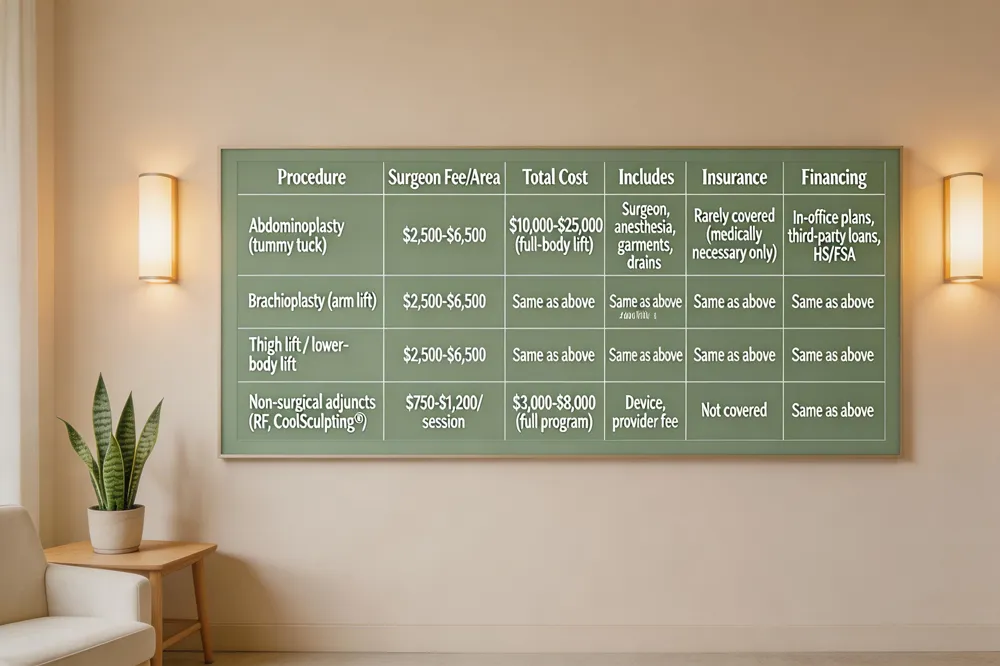
| Procedure | Typical surgeon fee per treated area | Total cost range (multiple areas) | Includes | Insurance coverage | Financing options |
|---|---|---|---|---|---|
| Abdominoplasty (tummy tuck) | $2,500‑$6,500 | $10,000‑$25,000 (full‑body lift) | Surgeon, anesthesia, facility, garments, drains | Rarely covered unless medically necessary (panniculectomy) | In‑office payment plans, third‑party medical loans, HS/FSA |
| Brachioplasty (arm lift) | $2,500‑$6,500 | Same as above | Same as above | Same as above | Same as above |
| Thigh lift / lower‑body lift | $2,500‑$6,500 | Same as above | Same as above | Same as above | Same as above |
| Non‑surgical adjuncts (RF, CoolSculpting®) | $750‑$1,200 per session | $3,000‑$8,000 for full program | Device, provider fee | Not covered | Same as above |
 Post‑weight‑loss body contouring most often involves surgical excision of excess skin and fat. The most common procedures are abdominoplasty (tummy tuck), arm lift (brachioplasty), thigh lift, and lower‑body lift, which may be combined in a single operation to reduce overall recovery time.
Typical surgeon fees range from $2,500 to $6,500 per treated area, with total costs rising to $10,000–$25,000 when multiple regions are addressed or when a full‑body lift is performed. Fees include the surgeon’s professional charge, anesthesia, facility fees, postoperative garments, and any necessary drainage tubes. Non‑surgical adjuncts such as radio‑frequency skin‑tightening or CoolSculpting cost $750–$1,200 per session; a full program can total $3,000–$8,000.
Insurance coverage is limited. Cosmetic contouring is generally not covered, but procedures deemed medically necessary—most often a panniculectomy for chronic skin irritation, infections, or functional impairment—may be reimbursed. To qualify, patients must maintain a stable weight (within 5–10 lb of goal) for at least six months, have a BMI ≤30, and provide a physician’s letter of medical necessity, photographs, and documentation of failed conservative measures.
Financing options are widely offered. Many practices, including Dermatology Associates, PC, provide in‑office payment plans, third‑party medical loans, and HS‑/FSA eligibility. A personalized pre‑operative consultation delivers an itemized quote, helping patients understand the exact investment and choose the most cost‑effective, safe route to their desired results.
Non‑Surgical Contouring & Skin‑Tightening Innovations
| Modality | Mechanism | Session length | Downtime | Typical result timeline | Fat reduction (circumference) | Skin‑tightening effect |
|---|---|---|---|---|---|---|
| Cryolipolysis (CoolSculpting®) | Controlled cooling induces adipocyte apoptosis | 30‑60 min | None (immediate return) | 6‑8 weeks for visible change; up to 6 months for final result | 15‑30 % | Mild improvement as collagen remodels |
| Radio‑frequency (Thermage, Morpheus8) | Heat stimulates neocollagenesis | 30‑60 min | None | 2‑4 months for firmer texture | N/A | Moderate to strong tightening |
| Focused ultrasound (Ultherapy) | Deep dermal heating triggers collagen | 30‑60 min | None | 2‑4 months for firmness | N/A | Strong tightening |
| Laser platforms (SculpSure®, Fraxel, CO₂) | Laser energy breaks down fat & resurfaces skin | 30‑60 min | None | 2‑4 months for texture refinement | 15‑30 % (SculpSure®) | Moderate tightening |
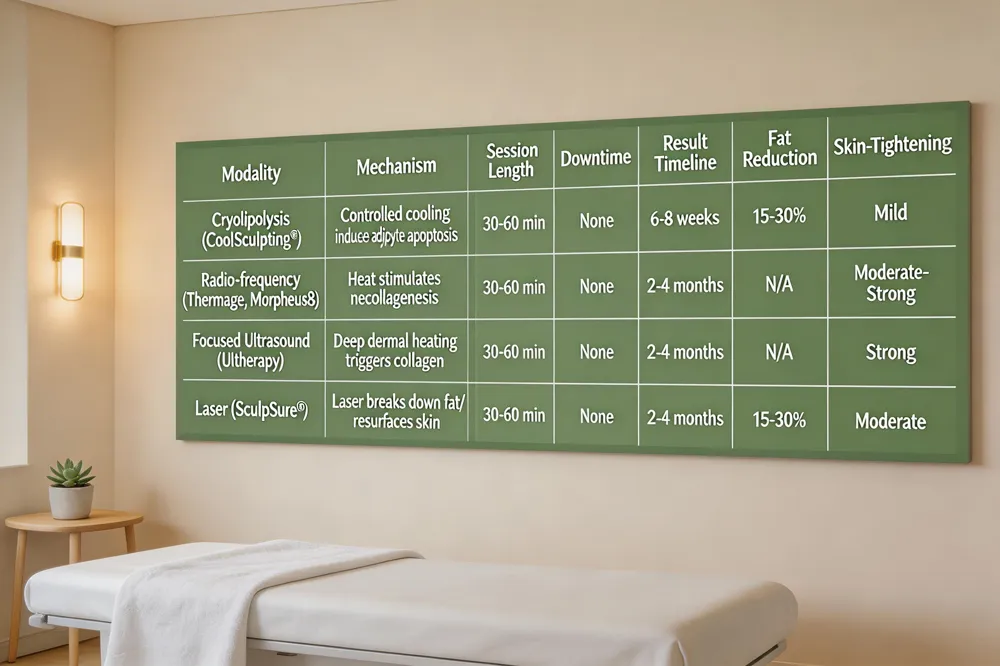 Non‑surgical body‑contouring exploits FDA‑cleared technologies—cryolipolysis (CoolSculpting®), radio‑frequency (RF) devices (Thermage, Morpheus8), focused ultrasound (Ultherapy, and laser‑based platforms (SculpSure®, Fraxel, CO₂). Each session lasts 30‑60 minutes, allows an immediate return to daily activities, and typically requires 3‑6 months for results to mature. Fat reduction per course averages 15‑30 % in circumference, while mild‑to‑moderate skin laxity improves as new collagen and elastin are stimulated. Ultrasound and RF heat deep dermal layers to trigger neocollagenesis, delivering firmer texture over 2‑4 months; laser resurfacing adds texture refinement and can address fine lines.
Non‑surgical contouring before and after – Before‑and‑after imaging from our practice shows smoother silhouettes on abdomen, flanks, thighs, and double‑chin areas after a recommended series of 3‑4 treatments, with little to no downtime.
Body contouring without surgery – These modalities are scar‑free but provide modest sculpting compared with surgical liposuction; multiple visits may be needed for larger bulges.
Best skin tightening after weight loss – For mild‑to‑moderate laxity, RF (Thermage, Morpheus8 and focused ultrasound (Ultherapy are the most effective non‑invasive options, delivering results that can last 1‑2 years when combined with weight stability and skin care. More extensive sagging still requires surgical lifts (abdominoplasty, brachioplasty, thigh lift for definitive removal.
Loose skin after weight loss removal – Surgical excision remains the gold standard for excess skin; non‑invasive tightening can only modestly improve firmness. Candidates should have maintained goal weight for ≥6 months and be in good health.
Skin‑tightening creams & natural methods – Retinol, peptides, hyaluronic acid, and vitamin C creams modestly boost firmness, while hydration, a protein‑rich diet, UV protection, and core‑strengthening exercise support collagen remodeling. For substantial laxity, procedural RF or laser treatments are recommended.
Reddit insights – Community anecdotes are useful, but personalized evaluation by a board‑certified dermatologist or plastic surgeon ensures safe, effective treatment planning.
Recovery, Side‑Effects, and Long‑Term Maintenance
| Phase | Recommendations | Common side‑effects | Activity restrictions | Long‑term care |
|---|---|---|---|---|
| Immediate post‑op (0‑2 weeks) | Wear compression garment ~6 weeks; keep area clean; follow dressing schedule | Bruising, swelling, mild discomfort, tingling | No heavy lifting, intense exercise, saunas, hot tubs, prolonged hot showers | Hydration, balanced diet, protein intake |
| Early recovery (2‑6 weeks) | Continue compression; attend follow‑ups for drain/suture removal | Residual swelling, seroma risk | Gradual light activity; avoid strain on incisions | SPF 30+ sunscreen after week 1; avoid harsh exfoliants/retinoids |
| Mid‑term (6‑12 weeks) | Monitor scar maturation; consider adjunct RF/ultrasound if needed | Scar formation, mild redness | Resume moderate exercise as tolerated | Sun protection, moisturizers, collagen‑supporting nutrients |
| Long‑term (≥6 months) | Maintain weight stability; regular exercise; skin‑care routine | Final contour settles; possible residual laxity | Full activity allowed | Ongoing SPF use, hydration, protein‑rich diet, core‑strengthening exercises |
 Post‑operative care after body‑contouring begins with wearing a compression garment for about six weeks to reduce swelling, support the incisions, and promote skin re‑traction. Patients should keep the area clean, change dressings as instructed, and attend scheduled follow‑ups for drain removal or suture review.
Common short‑term side effects include temporary bruising, swelling, mild discomfort, and a tingling or numb sensation that usually resolves within days to weeks. Surgical procedures (e.g., abdominoplasty, thigh lift carry additional risks of seroma, scarring, and, rarely, infection or bleeding. Non‑invasive modalities such as radiofrequency or cryolipolysis typically cause only mild redness and skin sensitivity.
Guidelines for activity, sun exposure, and skincare: avoid intense exercise, heavy lifting, saunas, hot tubs, and prolonged hot showers for the first 1–2 weeks; protect treated skin with broad‑spectrum SPF 30+ sunscreen after the first week; refrain from harsh exfoliants or retinoids until cleared by the surgeon; and maintain hydration and a balanced diet to support healing.
Managing expectations and long‑term skin health: most patients notice visible improvement after 3‑4 sessions (or after the first surgical stage), with final contour maturation occurring between 6‑12 months as scars settle and collagen remodels. Patients with mild‑to‑moderate laxity may benefit from adjunctive radiofrequency or ultrasound tightening, while severe excess skin often requires surgical excision for lasting results. Ongoing weight stability, regular exercise, and sun protection are essential to preserve skin elasticity and ensure durable outcomes.
Your Path to Confidence Starts Here
After major weight loss, patients can choose surgical lifts—such as abdominoplasty, brachioplasty, thigh lifts, and breast mastopexy—or non‑surgical skin‑tightening technologies like radiofrequency, ultrasound, and laser resurfacing. A personalized, medically‑guided plan starts with a thorough evaluation of skin elasticity, nutritional status, and weight stability, ensuring each procedure matches the individual’s anatomy and goals. Commitment to safety means board‑certified surgeons, evidence‑based protocols, and detailed education on postoperative care, while long‑term skin health is supported by nutrition, hydration, and ongoing skin‑maintenance strategies to preserve results and enhance overall wellbeing continuously.